“I thought my broker had brains, instead of being just a freaking salesman.”
“I’ll never deal with a Wall Street firm or broker. again You’re just asking to get screwed.”
“Their incentive (i.e. the brokers’) was totally misaligned from the investors’ interest. You’d think they’d had some semblance of morals. But they don’t.”
Yesterday I re-printed Gretchen Morgenson’s article “A Crack in Wall Street Defenses.” The article told the story of two rich guys from Aspen who got taken by Citibank’s brokerage division Smith Barney but then fought back through arbitration and got awarded $54.1 million — the largest amount ever awarded to individuals.
The article reiterated what I’ve said a thousand times on this column: Don’t touch Wall Street’s structured investments — especially ones that are structured (i.e. put together) for you.
The missing part of Gretchen’s article — I suspect it was cut to save space — was what the investments actually were. So I called Gerald D. Hosier, the main investor, and asked him what were the investments, what happened and what were the lessons. I got Hosier on his cell phone phone in France’s Loire Valley where he’d just completed a 45-mile bike ride. (Pretty good for a man aged 69.)
He was sold several investments. They all involved 8-10 times leverage. Typically the core investment was municipal bonds. The deals were sold by Smith Barney and the money borrowed largely from Citigroup. “Essentially, the deals were set up so the broker and Smith Barney reaped huge fees,” Hosier told me. “One deal had me borrowing $20 million on which their fees were$2.5 million — effectively a 25% interest rate over 18 months.”
All the deals were sold to Hosier on the basis that the deals were “as safe as cash.” Shades of auction rate preferreds. One of the key deals was called Municipal Arbitrage Trust, which somehow played the spread between munis and treasuries. When the yield curves reversed, the trust dropped in value and Citigroup called its loan, effectively wiping Hosier out — though its subsidiary Smith Barney had sold the deal “as safe as cash.”
It was hard to get all the details on the cell phone call. But as Hosier explained it, “This deal, with all its leverage, can go along swimingly for 100 days. But then one bad day and you’re dead. All your money is gone.”
I asked him about the SEC and local regulators.
Said Hosier, they don’t protect you. “The SEC and the local regulators — they’re lazy and they just want high-paying jobs on Wall Street.”
Some of his comments are above.
Keep reading. The world of investing gets more weird.
Short-term money market funds suck.Yesterday I discovered that a whopping 68.9% of Fidelity’s New York Municipal Money Market Fund is invested in something called “variable rate demand notes,” which were created by Wall Street after the auction rate preferreds disaster in February 2008. So yesterday I dumped the fund and went looking for something else. I researched short-term money market funds on Fidelity and found:

So, I figured what could be wrong with SPRXX (apart from a totally awful yield)? Here’s what I found:
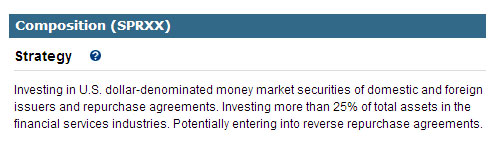
I’ve been studying investing since I sold the business in 1997. I have no idea what a “reverse repurchase agreement” is. And frankly, I don’t want to know. It smells big time.
I instructed Fidelity to transfer all my money market funds into cash. And, from now on sweep all the monies I get from selling stuff into cash. Plain ordinary cash. Nothing fancy. No variable demand notes. No reverse repurchase agreements. Just cash.
As Yogi said, cash is just as good as money.
What’s in your money market fund?
Trump Dogged By Rumors His Hair is Not From U.S. So-called ‘Balders’ Movement Gathers Steam

NEW YORK – A threat to the fledgling presidential campaign of Donald Trump emerged yesterday, as a group of activists charged that Mr. Trump is not eligible to hold the nation’s highest office because his hair does not originate from the U.S.
The group, who call themselves “Balders,” claim that the hair-like substance that crowns Mr. Trump’s head is from a foreign country, which would mean that the candidate is less than one hundred percent American.
“Time and time again, Donald Trump has refused to produce a certificate of authenticity for his hair,” said Leeann Selwyn, a leading Balder. “This is tantamount to a comb-over of the truth.”
But if Mr. Trump’s distinctive mane turns out to be of foreign origin, such a revelation need not be fatal to his presidential hopes, says Professor Davis Logsdon, who has studied the history of presidential hair at the University of Minnesota.
“Remember, several of our greatest early presidents, like George Washington and Thomas Jefferson, had hair that originated elsewhere,” Mr. Logsdon says. “The only thing that could kill Trump politically is if his hair turns out to be from France.”
At a GOP event in Iowa, Mr. Trump made no reference to the Balders controversy, and instead sounded an upbeat theme: “If I am given the chance to do the same magic I did for NBC, America will be the number four country in the world.”
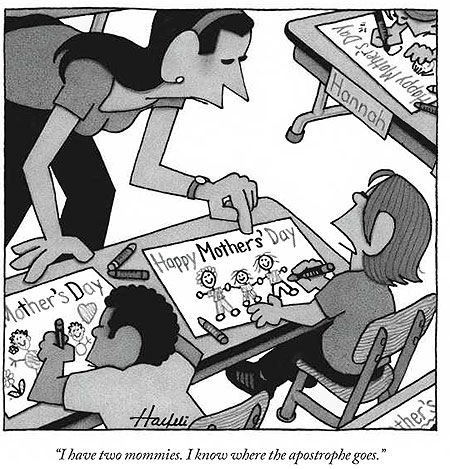
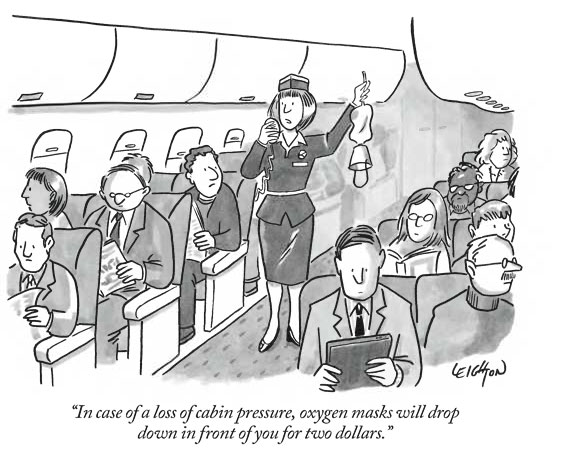
Favorite New Yorker cartoons.

Harry Newton who wonders about the latest Newton household philosophy of less being more. Yesterday Susan’s new iPad2 arrived. (I get the old iPad1 as a hand-me-down.)
The iPad2 is a nice machine, marginally improved and a tinge lighter. It has two cameras. There’s no easy way to hold the iPad. Hence it’s not easy take pictures with. I prefer the iPhone4. The iPad2 is relatively easy to set up and sync with the Outlook on your PC. Just takes a little fiddling. Unless you’re desperate for the cameras, there’s no real reason to upgrade to the iPad2.
We’re also getting a dog. And Amazon is getting rich. This is the 423rd book on dog raising Susan has bought in the last week.

The irony of the book’s cover is the dog purports to be on Central Park’s Sheep Meadow — where dogs are not permitted.

Harry, a repo is among the safest investments out there short of owning US treasuries. In fact, you probably would END UP with treasuries if a repo ever went bad since they are the security usually used to collateralize one. A repo is an overnight (or very short term) collateralized loan in the form of a repurchase agreement. E.g. Broker-dealer X has a load of treasuries, commercial paper, or other short-term high-grade money market instruments on hand (as part of its trading inventory or in trust for its customers in which case it's probably got permission from these customers to hypothecate them…and it needs cash to pay whoever sold them to the the dealer. Broker-dealer X sells them to Broker-dealer Y who takes actual possession of the securities and, in accordance with a repurchase contract governing the transaction, buys them back the very next day under for the same price plus a little interest. The rate on this interest is known as the overnight repo rate and it's one of the most widely quoted short term borrowing rates in the world, right up there with LIBOR. Broker-dealer X borrow money lots of other places, of course, but since it's securing the quickie loan with, say, treasuries, a repo is the cheapest money it will find. It's Wall-Street's version of a pawn shop for US treasuries and there isn't a money center bank in existence that doesn't use it.
Harry,
This won't be in standard dogs in city behavior books, but is important. So kindly pass my comments onto Susan and thoroughly review it with your dog(s). If your dog is off the lease and chases runners, it is considered very poor manners not to give the runner, if under 40 years old, a 20 foot head start, if 40-60, a 40 foot start and if over 60 a solid 60 feet. If over 70, it is considered very poor manners and poor sport to let your dog chase them. Bike riders are OK, let 'um go!
I just had a talk with a banker yesterday about monepy market funds and told her I was not a big fan of money market funds. Most of them are a way to draw very little interest and a good way to lose money if we get into another “meltdown” situration.
Nothing exotic about a reverse repo agreement. It's the buy side of an agreement to trade a security that will be traded back between parties at a fixed increase in price. As long as there is no leverage involved on the initial purchase you are basically dealing with credit risk on the repurchase by the municipal entity ala vanilla muni's..
For cash investments, try American Express Bank, Capital One Bank, Alliant Credit Union, or any of the choices at –
http://www.depositaccounts.com…
Stay under the FDIC/NCUA limits and you get better yields with government insurance- a far better alternative than the money funds.
I'm sure that in eight months, Susan will enjoy dog 2.0 even more.