Your bank has dozens of real estate properties on its balance sheet. These properties suck. It got these properties because the owners couldn’t pay their mortgages. You don’t want houses. You want income-earning property, preferably commercial buildings with real tenants.
You want to pay just enough such that your cash on cash return (i.e. without borrowing) is at least 15% to begin, with some possible upside, e.g. vacancies — space you can rent out cheaply.
Your “bank” is also your pension fund, your insurance company, your credit union, etc.
Banks are selling. Good stuff is selling — but quietly. No bank wants to put its stuff onto the open market and show the world
1. How stupid it is (or was), and
2. How much its balance sheet sucks. (This brings attention from the FDIC and other banking regulators.)
Deals are being done quietly. You need personal relationships to find them.
Your goal is to assure the bank that the property will be taken off their hands quickly, cleanly and for cash.
If you don’t have the cash, you can syndicate it to your friends.
If you’re not in that business, email me. I’ll put you in touch with any number of long-time successful real estate syndicators who have the property management skills and the investors dieing to invest in good, cheap properties with decent cash returns.
Happiness is a monthly dividend check.
Bank loans fall and fall;
Banks Continue To Pull The Rug Out From Under The Economy
Joe Weisenthal and Kamelia Angelova of Chart of the Day
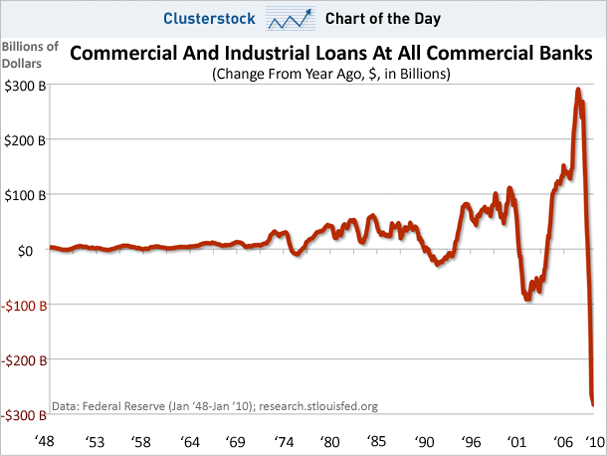
Can the economy revive if banks don’t start to lend again?
Let’s hope so.
Today (that was yesterday) the St. Louis Fed released its latest monthly look at commercial and industrial loans at major banks — a measure that some would say represents the essence of the US banking system.
As you can see, this measure is still falling like a knife — a bad sign for the ongoing health of the economy. (And also not what we were promised when we bailed out the banks.)
For Clusterstock’s site, click here.
Jobs for the boys:
+ A friend hires an actor to attend his swanky dinner parties. The actor is introduced as super-intelligent, super-accomplshed life-long friend. During the dinner, the “friend” begins a heated argument with the host. The host presents superb arguments. The friend leaves the party early — humiliated and forelorn. Meantime, the host looks like a million dollars to all his friends. Cost: $250.
+ Guests from hell descend on my New York City friend regularly. He’s annoyed. He hires an actor to “mug” the out-of-towners. Later that day he returns their wallets. But meantime, he’s soured them on returning to New York. Cost: $500.
Another old person joke.
Two elderly gentlemen from a retirement center were sitting on a bench under a tree when one turns to the other and says: ‘Slim, I’m 83 years old now and I’m just full of aches and pains. I know you’re about my age. How do you feel?’
Slim says, ‘I feel just like a newborn baby.’
‘Really!? Like a newborn baby!?’
‘Yes. No hair, no teeth, and I think I just wet my pants.’

Harry Newton, who sees bond yields low and stock prices high, and believes self-generated ideas (see Harass your bank above ) are today’s key.

Huh? Yesterday … “That’s it for me. I’m going positive. I now believe equity markets will do well in 2010 and that I should have more money in equities.” Cash is no longer king, yet commercial real estate loans are falling like a knife! When that finally becomes big news on networks and papers, should that cause a big market spill? or get in, but out in 6 months?
But do local banks (is there such a thing?) really hold a lot of foreclosed properties? Mortgages were bundled, quickly securitized and moved off of the balance. Most of the foreclosed homes are now held by various investors many of whom don't even have “work out rights”(i.e. the ability to do anything with them) to the properties. I have heard that custodians are making 25bps for managing the properties and making sure whatever payments are coming in get funneled to the owner, which can change day-to-day. The details are different but I believe the same is generally true for most commercial properties as well.
The big banks – BofA, Chase, etc. – do seem to have these properties on their balance sheets but can you as an individual go in there and make a deal, even if you do know the right guy?
You can't generalize about this. But I do know there are properties in the banks and other financial institutions that they will sell for a lot less than the properties were “worth” three years ago. I've seen examples.