They need to know:
1. There is no security in working for someone else — big giant company.
2. Do what you love, but do it for yourself.
3. You are your own worst enemy. No one shoots you in your foot more accurately than you do.
4. Education matters. Formal works. But the best education is parent-children. They may not learn from your mistakes. You didn’t. But at least they hear them.
5. Love works. There will be better times. But meantime, we need each other. See today’s misery as a bonding opportunity.
Was It All Just A Bad Dream? Or, Ten Lessons Not Learnt. That’s the title of a February, 2010 White Paper from James Montier who works at GMO, which is Jeremy Grantham’s money management operation, which manages more money than I’ve ever dreamed about. The ten lessons are:
1. Markets aren’t efficient.
2. Relative performance is a dangerous game.
3. The time is never different.
4. Valuation matters.
5. Wait for the fat pitch.
6. Sentiment matters.
7. Leverage can’t make a bad investment good, but it can make a good investment bad.
8. Over-quantification hides real risk.
9. Macro matters.
10. Look for sources of cheap insurance.
He concludes:
Will we learn?
Sadly the evidence from both history and psychology is not encouraging when it comes to supporting the idea that we might learn from our mistakes. There is a whole gamut of behavioral biases that prevent us from learning from mistakes. However, just this once I really hope this time is different!
You can read the entire paper on GMO’s web site.
Greenspan gets paid to deliver gloom and doom. Heh. I could use this job. Get paid $100,000 or so to give a sick speech. Here’s the report on it. Sadly he’s right about the mess.
Greenspan Says Crisis `By Far’ Worst, Recovery Uneven
Feb. 23 (Bloomberg) — Former Federal Reserve Chairman Alan Greenspan said the financial crisis was “by far” the worst in history and called the recovery from the global recession “extremely unbalanced.”
The world economy has undergone “by far the greatest financial crisis globally ever,” Greenspan said today in a speech to the Credit Union National Association’s Governmental Affairs Conference in Washington.
Greenspan said that while the economy was in worse shape in the Great Depression, the recent financial crisis was potentially more harmful than that in the 1930s because “never had short-term credit literally withdrawn.”
Remember my chart from yesterday?
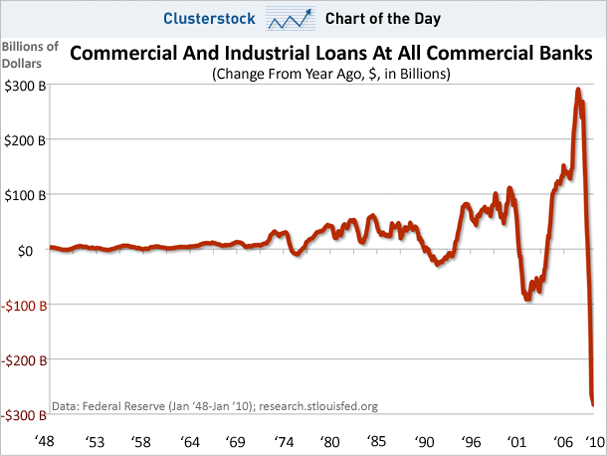
Greenspan said that the gross domestic product may recover to the level of previous peaks earlier this year, even though traditional drivers of growth such as housing starts and motor vehicles were “dead in the water.” He also said small businesses show few signs of improving because lenders are struggling with commercial real estate mortgages.
The “extremely unbalanced recovery” is being led by high- income consumers and large businesses that are benefiting from a recovery in stock prices, he said.
Greenspan said that the financial system is “not yet to the point where the capital positions of the largest banks is built up to where they’re freely lending.”
Greenspan also said “fiscal affairs are threatening this outlook” for recovery, as Congress and the White House face difficulty raising taxes or cutting spending. He said that every day he checks the interest rate on 10-year Treasury notes and 30-year Treasury bonds, calling them the “critical Achilles Heel.”
The financial crisis was caused by a “fundamental misjudgment in the marketplace,” Greenspan said. Greenspan defended markets, because other forms of economic organization are worse.
I bet he likes waterboarding too, because other forms of torture are worse, too.
Here’s his zinger:
Greenspan said he wants the subprime mortgage market to return. “I hope we can find a way of resurrecting the subprime market,” because it was working well until those mortgages were widely securitized, he said.
Factoid of the day: More than half of all portfolio managers tracked by Morningstar didn’t invest in their own funds during the past five years.
Check. Check. Check. The Internet distorts and alarms. You cannot believe what you read on the Internet. Sample:
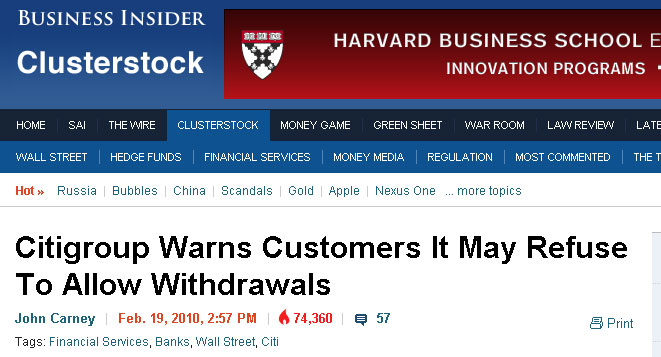
I called Citi and asked “What’s the story?” Apparently I was the only financial blog writer who did. The rest just published that Citi could refuse to allow withdrwals for seven days from its customers’ checking accounts.
The story is simple. Under FDIC regulations (yes, another brilliance coming out of Washington), there are two types of checking accounts:
1. NOW account. It stands for negotiable order of withdrawal. These accounts (typically for individuals) are eligible for interest or promotions — like toasters. Remember them?
2. Demand deposit accounts (DDA)– typically offereed to business customers — are non interest and non promtion accounts.
The quid-pro-quo for getting all the goodies on the NOW account is that the bank could say to you, “We need seven days before we can put your check through.”
Last year, Citi converted all its NOW accounts into DDA, because that gave the accounts expanded FDIC insurance. This year they moved the DDA accounts back to NOW accounts. And so they sent a notice to every one of their customers telling them that Citi could demand seven days notice before cashing one of their checks.
Why Citi brought this bad publicity on itself escapes me — unless, of course, my toaster is in the mail.
This is priceless. This is the cartoon the child drew after the teacher asked “Draw what your mother does for a living.”
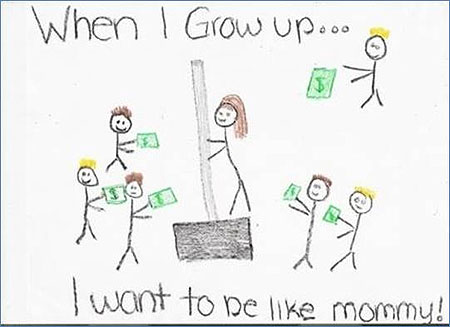
This is the explanation:
Dear Mrs. Logan,
I wish to clarify that I am not now, nor have I ever been, an exotic dancer. I work at Home Depot and I told my daughter how hectic it was last week before the blizzard hit. I told her w e sold out every single shovel we had, and then I found one more in the back room , and that several people were fighting over who would get it. Her picture doesn’t show me dancing around a pole. It’s supposed to depict me selling the last snow shovel we had at Home Depot. From now on I will remember to check her homework more thoroughly before she turns it in.
Sincerely,
Mrs. Schreizer
Broken record. Facts: Computers are totally unreliable. They break only at the most inconvenient moment. Mine did on the weekend. Fortunately I had backups of all my working files and I had a cloned hard drive. Pop the clone in. Copy the working files over. Bingo, I’m back in business.
Lessons learned: Only one: I tried to repair the hard disk with new, updated drivers, which I downloaded from the Internet. They didn’t work. Surprise. Surprise.
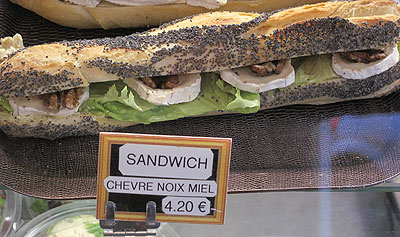
Paris remembered: No one makes sandwiches like the French do.
Few have views like this. Look carefully. That’s Rodin’s Thinker sitting among the trees.

Paris is a walking town. Around a corner, you’ll find wonderful surprises, like this darling church:

It’s not Notre Dame. I have no idea what it’s called. If you going to Paris email me and I’ll send you my list of Must Things To Do in Paris.

Harry Newton, who’s feeling ultra-mellow today, but doesn’t know quite why.

Greenspan seems always in thrall of intangibles. First it was Ayn Rand and the superhero. Then came efficient market theory. Later came the belief in Holy Quants. Lately he has become something of Big Bang Theorist, econ-style. He sees black holes but fails to understand their nature. Why do people pay $100,000 to listen to him? It's essentially the same reason people pay Paris Hilton $100,000 to show up at a party.
Like yesterday, the chart that I could see stopped at 1996…then I left clicked on the chart header and that appeared…right hand side to 2010. Wow, a plane crash straight down.
Hope this helps other frustrated readers to see the whole chart.
I'm making the charts smaller, so you won't have to go through this nonsense. I do recommend to everyone that they buy at least a second screen — a bigger one.
In case you can't travel to Paris, the “Thinker” also happens to be sitting in Philadelphia in front of the Rodin Museum. http://www.rodinmuseum.org/
Montier's presentation (from back in December, actually) can be viewed here:
http://myinvestingnotebook.blogspot.com/2009/12…
— Jack Krupansky