Last night, the private wealth management group of a huge bank invited my wife and me to a museum opening gala party. It was a nice idea, horribly implemented. I highlight the disaster not because I want to poke at the bank. I’m not mentioning their name. But to make a point: The devil is in the details. All the disasters could have been solved with a little planning. Items:
1. Our guide was too quiet and our group too big. In French museums the guide has a mike and a small transmitter. Each member of the group has an earphone and can hear the guide clearly. I couldn’t hear a word last night.
2. Parties are meant to have wine and cheese, or at least something to nibble on. Especially after a long day at the office. A way to welcome the privileged guests. This one may have had something but we were shooed away from the food and drinks because there was some fear that a hanging exhibit was about to fall. It never did and we never got a drink. Not even water.
3. The museum itself was a disaster of neglect. There were video works of art that didn’t work. There were audio works that were so loud they were headache-inducing and polluted adjoining rooms. There were windows which seriously needed cleaning. A razor blade and little Windex would have produced wonders. I felt like offering.
4. I don’t need to hear that my bank has the largest art collection of any bank in the world. I now know where my fees go. Nor do I need to hear how much the Museum is indebted to the bank for funding. As a bank client, I want to be warmly thanked for schlepping out on a cold night.
Forgive me. I’m not bitching. I used to run trade shows, seminars and conventions. My biggest convention attracted 26,000 people. I walked the floors constantly, checking, checking and more checking. I’d pick up paper from the floor. I’d arbitrate disputes on the spot between adjoining booths. I extended hours when people were still doing business at closing time. I outlawed giving away popcorn because it made a mess. And I swept the walkways.
You have to have someone in charge. And you have to have them pay attention to the details.
The bank is not the only one neglecting the details. Yesterday a software company looking to hook me for an investment sent me a PowerPoint. The presentation had typos and spelling mistakes. It was so badly laid out that many of the slides weren’t readable — unless you opened up the PowerPoint and re-arranged the words.
Gimme a break with the BS. I found this on a web site yesterday:
WHO WE ARE
+Unrivaled Expertise. Blah. Blah. Blah.
+Uncommon Experience. Blah. Blah. Blah.
+Breakthrough Technology. Blah. Blah. Blah.
I don’t think they said they walk on the water. But it sure read that way. Only one person I know walked on water and was credible.
How banks bet against their customers. I have harped on three lessons:
1. Don’t buy products Wall Street manufactures.
2. Don’t expect Wall Street’s interest in your future to last longer than it takes to sell you something and pocket the commission.
3. Their interest is theirs, not yours. Canon, Apple, Ford, Toyota and even Mercedes stands behind their products far better than Wall Street.
What we’ve now learned is that Wall Street will sell you something it believes is drek and then actively bet against you, forcing your part-drek to become real-drek. Two classic articles by Matt Taibbi of Rolling Stone talk about this nasty Wall Street habit. The latest article is Wall Street’s Bailout Hustle. A previous good one was The Great American Bubble Machine. Today’s New York Times has this disturbing story.
Banks Bet Greece Defaults on Debt They Helped Hide
By NELSON D. SCHWARTZ and ERIC DASH of the New York Times
Bets by some of the same banks that helped Greece shroud its mounting debts may actually now be pushing the nation closer to the brink of financial ruin.
Echoing the kind of trades that nearly toppled the American International Group, the increasingly popular insurance against the risk of a Greek default is making it harder for Athens to raise the money it needs to pay its bills, according to traders and money managers.
These contracts, known as credit-default swaps, effectively let banks and hedge funds wager on the financial equivalent of a four-alarm fire: a default by a company or, in the case of Greece, an entire country. If Greece reneges on its debts, traders who own these swaps stand to profit.
“It’s like buying fire insurance on your neighbor’s house – you create an incentive to burn down the house,” said Philip Gisdakis, head of credit strategy at UniCredit in Munich.
As Greece’s financial condition has worsened, undermining the euro, the role of Goldman Sachs and other major banks in masking the true extent of the country’s problems has drawn criticism from European leaders. But even before that issue became apparent, a little-known company backed by Goldman, JP Morgan Chase and about a dozen other banks had created an index that enabled market players to bet on whether Greece and other European nations would go bust.
Last September, the company, the Markit Group of London, introduced the iTraxx SovX Western Europe index, which is based on such swaps and let traders gamble on Greece shortly before the crisis. Such derivatives have assumed an outsize role in Europe’s debt crisis, as traders focus on their daily gyrations.
A result, some traders say, is a vicious circle. As banks and others rush into these swaps, the cost of insuring Greece’s debt rises. Alarmed by that bearish signal, bond investors then shun Greek bonds, making it harder for the country to borrow. That, in turn, adds to the anxiety – and the whole thing starts over again.
On trading desks, there is fierce debate over what exactly is behind Greece’s recent troubles. Some traders say swaps have made the problem worse, while others say Greece’s deteriorating finances are to blame.
“This is a country that is issuing paper into a weakening market,” said Ashish Shah, co-head of credit strategy at Barclays Capital, referring to Greece’s need for continual borrowing.
But while some European leaders have blamed financial speculators in general for worsening the crisis, the French finance minister, Christine Lagarde, last week singled out credit-default swaps. Ms. Lagarde said a few players dominated this arena, which she said needed tighter regulation.
Trading in Markit’s sovereign credit derivative index soared this year, helping to drive up the cost of insuring Greek debt, and, in turn, what Athens must pay to borrow money. The cost of insuring $10 million of Greek bonds, for instance, rose to more than $400,000 in February, up from $282,000 in early January.
On several days in late January and early February, as demand for swaps protection soared, investors in Greek bonds fled the market, raising doubts about whether Greece could find buyers for coming bond offerings.
“It’s the blind leading the blind,” said Sylvain R. Raynes, an expert in structured finance at R&R Consulting in New York. “The iTraxx SovX did not create the situation, but it has exacerbated it.”
The Markit index is made up of the 15 most heavily traded credit-default swaps in Europe and covers other troubled economies like Portugal and Spain. And as worries about those countries’ debts moved markets around the world in February, trading in the index exploded.
In February, demand for such index contracts hit $109.3 billion, up from $52.9 billion in January. Markit collects a flat fee by licensing brokers to trade the index.
European banks including the Swiss giants Credit Suisse and UBS, France’s Société Générale and BNP Paribas and Deutsche Bank of Germany have been among the heaviest buyers of swaps insurance, according to traders and bankers who asked for anonymity because they were not authorized to comment publicly.
That is because those countries are the most exposed. French banks hold $75.4 billion worth of Greek debt, followed by Swiss institutions, at $64 billion, according to the Bank for International Settlements. German banks’ exposure stands at $43.2 billion.
Trading in credit-default swaps linked only to Greek debt has also surged, but is still smaller than the country’s actual debt load of $300 billion. The overall amount of insurance on Greek debt hit $85 billion in February, up from $38 billion a year ago, according to the Depository Trust and Clearing Corporation, which tracks swaps trading.
Markit says its index is a tool for traders, rather than a market driver.
In a statement, Markit said its index was started to satisfy market demand, and had improved the ability of traders to hedge their risks. The index and similar products, it added, actually make it easier for buyers and sellers to gauge prices for instruments that are traded among players over the counter, rather than on exchanges.
“These indices have helped bring transparency to the sovereign C.D.S. market,” Markit said. “Prior to their creation, there was no established benchmark index enabling investors to track the performance of segments of the sovereign C.D.S. market.”
Some money managers say trading in Greek swaps alone, not the broader index, is the problem.
“It’s like the tail wagging the dog,” said Markus Krygier, senior portfolio manager at Amundi Asset Management in London, which has $40 billion in global fixed-income assets. “There is a knock-on effect, as underlying positions begin to seem riskier, triggering risk models and forcing portfolio managers to sell Greek bonds.”
If that sounds familiar, it should. Critics of these instruments contend swaps contributed to the fall of Lehman Brothers. But until recently, there was little demand for insurance on government debt. The possibility that a developed country could default on its obligations seemed remote.
As a result, many foreign banks that held Greek bonds or entered into other financial transactions with the government did not hedge against the risk of a default. Now, they are scrambling for insurance.
“Greece is not a small country,” said Mr. Raynes, at R&R in New York. “Credit-default swaps give the illusion of safety but actually increase systemic risk.”
My favorite laptop just got much faster. I write this column on a ThinkPad X200. Next Monday I’ll order the new X201, which is much faster (between 30% to 50%) and little smaller and lighter. ThinkPads are the workhorses of many businesses I know. They’re pretty well indestructible. They have a great keyboard and a pointing stick (which lets you fly). You can get them running XP or Windows 7.
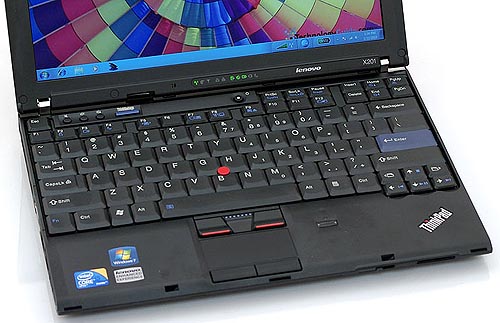
I highlight the keyboard. Notice the red pointing stick (it’s the fastest mouse in the world). Note they’ve also added a small trackpad (also called touchpad) in case you prefer that way of getting around.
How to sell rubbon.
Goldstein, in his late 80’s and still gainfully employed as a ribbon salesman, has been trying unsuccessfully to sell ribbon to Macy’s for many years.
He tries again.
“Goldstein,” the buyer says, “You’ve been trying to sell me ribbon for at least 25 years. Now is your chance. Send me enough yellow ribbon to reach from the tip of your nose to the tip of your penis.”
Three days later, 4 tractor trailers full of yellow ribbon drive up to Macy’s receiving dock. The ribbon buyer goes ballistic. He calls Goldstein and yells, “What’s going on? I ordered enough ribbon to reach from the tip of your nose to the tip of your penis. You send me 4 truck loads full of ribbon.”
Goldstein replies calmly, “The tip of my penis is in Poland .”

Harry Newton, who remembers when ships lined Singapore harbor awaiting cargo and bank financing. My friend just arrived there emails me. “Lots of ships picking up and dropping off lots of cargo. This place is back on fire again. Our biggest concern has been that it’s overheating, actually.” In short, the world is coming back. There’ll still be oodles of bumps, like Greece. But it is coming back.

Comment: No login below!
Real comment:
RE Greece default, couldn't Greece buy CDS on their debt and then default and collect, then pay off their debts???
You've got a good brain. My answer is why not?
you should send your “review” of the evening at the museum to concerned parties – maybe someone will pay attention! I recently attended 3 open houses of mid to higher priced homes. Two were in such disarray, with unkept yards and cluttered rooms, that I turned around in the entry and left. The third was vacant and in pristine condition. What is wrong with realtors in that they show homes that are not in show shape? Either refuse to list or show such a place, or educate the homeowners, or else, do what my mother, a very successful realtor in her day used to do – she'd clean the place, and have us kids mow the yard the day before, and send a bill to the escrow company!
It was Deutsche Bank at the Whitney Museum — a very prominent New York
museum.
I have no idea what's wrong with marketing people.
Harry Newton
50 Central Park West
New York, NY 10023
212-712-2833
Cell 917-297-1818
Weekends 518-392-3300
InSearchOfThePerfectInvestment