MITT is coming this morning. It’s called AG Mortgage Investment Trust, Inc. It’s a mortgage REIT/investment trust thing. The prospectus says, it “is a newly formed Maryland corporation that will invest in, acquire and manage a diversified portfolio of residential mortgage assets, other real estate-related securities and financial assets.” It is expected to yield 14% or so. It’s managed by Angelo Gordon, a really good investment manager. MITT is oversubscribed. There’s big private and institutional demand. I put in for some. Here’s the MITT red herring prospectus: Click here MITT Prospectus. Here’s a Wall Street Journal piece on the deal. Click here.
The Atlantic magazine runs its Idea Issue.

The best pieces are very depressing:
5. The Arab Spring Is a Jobs Crisis. Click here.
6. Wall Street: Same as It Ever Was. Click here.
Wall Street will sell anything that sells. Here’s its latest idea, from today’s New York Times DealBook:
New Investment Strategy: Preparing for End Times.
Investment professionals have a new pitch: The sky could soon be falling.
While Greece took a step back from the brink on Wednesday, the possibility of a default remains a fear. Europe’s debt crisis, as well as natural disasters and political uprisings, are prompting investors both big and small to seek out investments that promise to protect their portfolios in the event of economic Armageddon.
Worried that Greece could go belly up? So-called black swan funds — named for rare and unexpected events — offer a way to profit in the event of a market collapse. Think a slowdown in the United States or China could set off a global economic crisis? New exchange-traded funds are popping up to help pad investor confidence.
Since the financial crisis, many investors have prospered from a rebound in the markets. But recent events have led some to brace for the worst.
“Clients are suddenly realizing the world isn’t as rosy as it’s been,” said Ahmed Fattouh, a hedge fund executive. “It makes a lot of sense to have these tail protections on.”
That is, protections against what Wall Street calls “tail risk” — a disaster that is estimated to have less than half a percent chance of happening.
Investors learned about tail risk the hard way. For decades, diversification — spreading holdings across stocks, bonds and other investments — was promoted as the way to protect investments from market crashes. But the financial crisis proved that seemingly unrelated assets could fall in unison. As a result, an increasing number of investors now want protection for financial end times.
Bryce Vickmark for The New York TimesZvi Bodie, a professor of finance at Boston University School of Management.
These funds and offerings, usually costly and complicated, can be likened to insurance. Investors lose money on them during normal times, but they stand to gain if catastrophe strikes. Tens of billions of dollars are in such investments, representing a small but growing fraction of the investment world, particularly for a strategy that many investors would have scoffed at five years ago as expensive and unnecessary.
“In the last decade, we saw two stock market crashes, which wiped out any gains for investors over the decade and meant disaster for those who had to take their money out to meet big expenses at market lows,” said Zvi Bodie, a professor of finance at Boston University School of Management. That, he said, “has just made the current generation of investors more aware that it is risky even over a decade or more.”
Wall Street lawyers say money manager clients have approached them in recent months about forming new funds aimed at providing protection. Banks like Goldman Sachs are marketing tools engineered to bulletproof investors. Products linked to an index known as the market’s “fear gauge” total nearly $2.5 billion. And in the last year, the amount of money managed in dedicated tail-risk accounts by the bond giant Pimco has doubled to $23 billion.
Boaz Weinstein, a former trader at Deutsche Bank who lost more than $1 billion of the bank’s money during the financial crisis, began raising money for his own Armageddon fund late last year. It has since grown to $400 million of mostly institutional money, part of the $3.3 billion he has raised for his hedge funds.
John Kolesidis/ReutersIn Athens, a man protested Greece’s passing of austerity measures. Europe’s debt crisis is prompting some investors to seek investments that promise portfolio protection.
“Some investors after nursing those losses say, ‘I’d be much happier in return for not having that kind of downside to reinvest 1 percent of my portfolio in tail hedging,’ ” he said.
Investors include big public pensions. Joelle Mevi, the chief investment officer of New Mexico’s public employee pension fund, recently presented some tail risk options to her board. “While I wouldn’t tend to put a very large allocation there, I believe in having that type of insurance for the funds,” she said.
But protection does not come cheap and occasionally fails to work. Some say such funds are merely the latest Wall Street fad and may be ineffective because they are designed to protect against the last catastrophe, not the crisis to come.
“I kind of believe that the best way to reduce risk is to take things out of the portfolio, not add them,” said Ken Grant, president and founder of Risk Resources.
Although the names tail risk funds and black swan funds are often used interchangeably, they are distinct. Tail risk events are situations that, while conceivable, are highly unlikely based on mathematical modeling. By contrast, a black swan — a concept popularized by Nassim N. Taleb’s 2007 book “The Black Swan” — is an event that models fail to predict.
So how do such Armageddon funds work? Take a situation like the collapse of China’s economy, an event considered highly unlikely. While most American investors do not own Chinese stocks, real estate or currency, the fear is that a shock to China would spread to the rest of the world. As the stock markets fell, a tail risk or black swan fund would profit because it owned the options to sell shares in the Standard & Poor’s 500-stock index at far higher levels. The more the index dropped, the more valuable those options would become.
Gary Howe for The New York TimesMark Spitznagel on his 200-acre farm in Northport, Mich.
At Universa Investments, Mark Spitznagel, a former partner of Mr. Taleb’s, has raised more than $6 billion for a fund that is awaiting a market calamity. In the meantime, he acknowledges, it is losing money nearly every day. Part of the reason is that he buys options to sell a given stock in the future for a price below where it is currently trading. If the stock doesn’t move, or rises, the option is worthless, and he loses money. But if the share price tanks, he can make substantial profits.
Mr. Spitznagel, one of the more experienced doomsday managers, derides those who have jumped into the game recently. It takes a special kind of person to manage these kinds of investments, he says — people capable of slowly taking losses, without losing their composure.
“It takes someone that’s a little bit nuts,” he said. “I’ll do a trade, then say, ‘This is the best trade I’ve ever done in my career, but I’m quite sure I’m going to lose money on it.’ ”
“I understand my payoff and I understand these are very small losses relative to what I know I’m going to make eventually.”
Others are raising money to bet against the world. Capula Investment Management has raised some $2 billion, while 36 South Capital Advisors, a London-based fund that returned more than 200 percent during the 2008 crisis, is at $300 million and counting.
Not all investors are sold.
“Tail risk is out there, we all know it’s out there, but if you have 20 some hedge funds, you’re really looking for strategies that work in the total picture,” said Craig Slaughter, who oversees roughly $12 billion as the head of the West Virginia Investment Management Board. “Focusing on tail risk strategies — I’m just a little suspicious. It’s a little bit of a sales technique.”
Happy reader.
2011 Wimbledon TV Schedule. The Finals are this weekend. It’s on live – ESPN2 and NBC (All times Eastern) The Tennis Channel runs re-runs (called Encores or Premieres at night. Federer is is playing Tsonga as I write this column. It’s on ESPN2.
Thursday, June 30, 7 am – 12 pm, Women’s Semifinals, ESPN2
Thursday, June 30, 12 pm – 5 pm, Women’s Semifinals, NBC
Thursday, June 30, 9 pm – 11 pm, Women’s Semifinals, ESPN2
Friday, July 1, 7 am – 12 pm, Men’s Semifinals, ESPN2
Friday, July 1, 12 pm – 5 pm, Men’s Semifinals, NBC
Friday, July 1, 8 pm – 11 pm, Men’s Semifinals, ESPN2
Saturday, July 2, 9 am – 2 pm, Women’s Final, NBC
Sunday, July 3, 9 am – 3 pm, Men’s Final, NBC

Harry Newton who spent a little of yesterday biking in New York’s glorious weather. The city is teaming with tourists, carrying shipping bags (full of stuff made in China?) and filling our booming hotels. The city is clean and safe. Come visit.
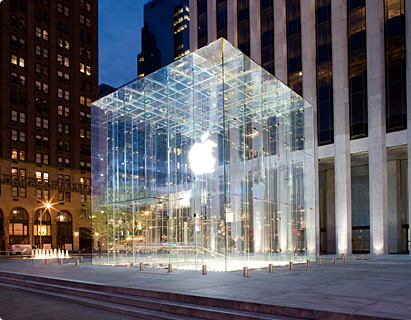
This is what the main Apple store on Fifth Avenue used to look like.
This is what it looked like yeterday, sheathed in thick plywood.
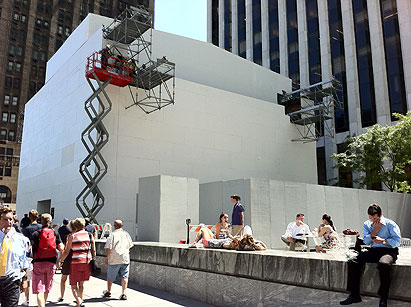
An Apple greeter said he had no idea what was going on. “You know Apple. They always got something neat up their sleeve.”
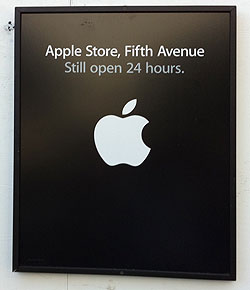
During construction, the store remains open:
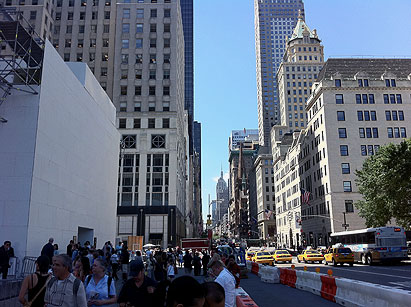
Looking down Fifth Avenue, you can actually see the Empire State Building in the almost azure blue skies.
Michael says yesterday’s picture of him was totally horrible. He is not 49, as one reader guessed. He’s a handsome 29. Blame his proud father for the ugly photo.
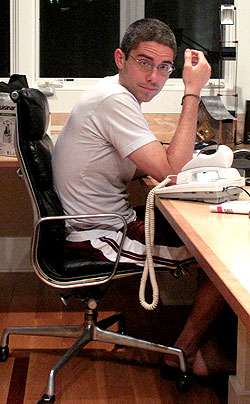
Life is wonderful. Michael is visiting in New York. Anne, his wonderful wife, is in Portland, Oregon. I guess no grandchildren this week.

Was in Wash DC this past weekend giving a talk. The city was bustling with people walking, shopping, eating, touring and having a delightful time. The northeast section, which when I worked in DC used to be a very tough neighborhood, is full of cafe's, restaurants and such, very much gentrified. In traveling the whole city I saw only 2 “For Rent” signs and across from a school in the wealthy northeast part of town, the only “For Sale” signs in front of 4 homes on that one block. My reaction to all this was anger, yes, ANGER; this city is booming, showing obvious signs of wealth and money on every corner, because of wasteful fat-cat spending and the continued massive growth of GD government. Our tax money “at work”. It's a lovely world totally disconnected from the rest of America where “For Rent” and “For Sale” signs dot almost every block. That's even true in relatively well-off Sonoma County where I live, where my town has a 40% commercial vacancy rate, down from 44% last year. It's no wonder that our clueless politicians of both parties living in that beautiful wealthy environment don't have a clue about the real world that they are supposed to represent and that pays for this luxury.
We have the best government that money can buy – and it has been bought, probably as never before. The money sources are easy to identify – that giant sucking sound we all hear is that of the wealth of this nation being vacuumed from the pockets of 100 million-or-so struggling Americans, and into the coffers of a mere handful of oligarchs, as engineered by their cohorts (i.e., lobbyists) and the politicans in their thrall who ensure that the moneyed class (yes, the term “class” is carefully chosen) is rewarded with wealth without limit or end.
Your description of Washington is utterly disturbing and, I am quite sure, totally accurate. Our nation's capital is now Baghdad by the Potomac. What shall be the end result of this unsavory evolution?
Reaganhood: take from the poor; give to the rich.
Peter – Harry often uses an old saying that sounds something like…”Washington, D.C. is 8 square miles surrounded by reality.” It is funny how their vehicle license plates say, “Taxation Without Representation” …they must be talking about the South East part of D.C.
I'm reading your latest using my Zenni reading glasses. Love them; they work great and fit just right. Total cost was about $20 – and that included a pair of polarized clip-ons.
With all the money I've overpaid on eyeglasses over the years, I only wish that Zenni had existed a long time ago. I live in dread fear that Luxottica (i.e., LensCrafters) will make them an offer they can't refuse and buy them out.
Need reading glasses? Go to the Dollar Store, but warning…The raised the price to $1.50.
Doesn't work for astigmatism or near-sightedness.
After having grown up in NYC and now living in Portland this picture of you son should have a caption reading: “they can't be serious, now they want more taxes.”…….Harry, your sons not 30 yet and he already shows signs of “snow on the roof”……maybe it's time to consider voting conservative.
Harry, you say “the city is clean and safe. Cone visit.”…….maybe in your opinion, but the truth is the city was much cleaner and safer under Mayor Rudy…….and you know it. But in the world of ultra-liberal NYC upper east and west side propaganda bullshit no one is allowed to say “it” even when speaking privately……the-rules-are-the-rules.
Too much caffein…”we live in the greatest of countries”
Harry have a fabulous 4th of July weekend and raise some hell by setting off 2000 firecrackers in your neighbors yard…yahooo…thats my plan…..maybe in jail on the 5th…what the hell, life is short “make it wild”….we live in the greatest of great country, we all need to celebrate our blessings….enjoy….D/Texas
Harry-
I can also heartily endorse Zenni. I have pruchased glasses for myself, my wife and and my children from there and they do a great job. I also have had the glasses checked after I received them and they were spot on. I am also wearing a pair as I type this. No line progressive bifocals are probably one of the best values. I can purchase inexpensvie glasses for my kids and not worry about them breaking a $150 pair of glasses. In fact my kids have several pair at those prices!
Steve H.