The last ten days.
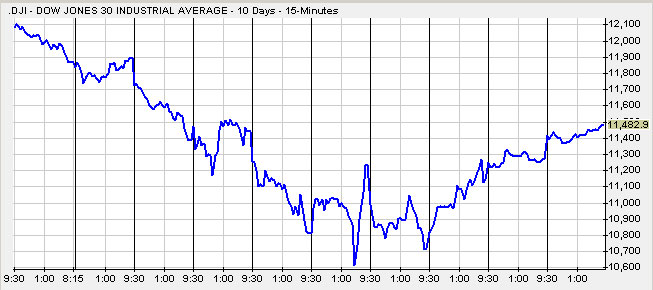
My strategy remains simple: Tight stops. Buy when prices appear to be low. I picked up a little BHP on Friday. Stay heavily in gold and mortgage REITs — like NLY and AGNC.
Little else is working — e.g. techs and big Dow Jones caps. Today looks weak. Maybe I’ll pick up some more Caterpillar. Maybe some more gold and maybe a little Apple. Not especially fun, this market. Too unpredictable. Too much fear. Have to stay on top of it every moment.
I sold my few Google shares yesterday. The news reports said Google has spent the phenomenal amount of $12.5 billion to buy Motorola Mobility’s patents (and it s manufacturing business). My first thought: If those patents were so valuable, how come Motorola hadn’t made more money on them? How come Motorola didn’t dominate the mobile/smartphone marketplace? My second thought was: heck, some of those 17,000 patents must be older than I am. And about as useful. Third, I find the whole business of suing competitors on spurious patent infringement claims to be morally repugnant. It’s not that I want to deprive lawyers of their living (though I do), it’s that I’d rather companies I inevest in devote their precious resources to something more productive — like making new, innovative products — instead of suing each other. I now despair for Google. Perhaps they actually intend to run Motorola’s crappy cellphone business? Imagine the diversion of management attention away from search to manufacturing and legal. Yuch Yuch. Business Insider summed up my thoughts:
But let’s be real: This deal could end up being a disaster.
How?
Well, for starters, the deal creates major channel conflict: Google is now competing with its partners. And hardware manufacturing is an entirely different kind of business than Google’s core business. And hardware manufacturing is a crappy, low-margin commodity business. And Motorola is massive–Google has just increased the size of its company by 60%. And the deal appears to be purely a defensive move, not an offensive one. And so on.
Let’s have a look at some of the host of questions and challenges the deal raises, starting with the channel conflict:
How do HTC and Samsung, two of the leading Android-based smartphone makers, feel about the fact that their “partner” Google is now competing directly with them for hardware sales?
And we mean, how do they really feel, internally, not “what are they saying in public?” (The quotes Google has assembled from HTC, LG, et al, all appear to have been written by the same PR person–note the similarity in the language.)
The only reason Android (and Google) have any share of the mobile game, after all, is because hardware makers like HTC and Samsung adopted Google’s software platform. And now Google is stabbing them in the back.
By now, it’s probably too late for Samsung and HTC to switch to another platform, so they’ll have to smile and make the best of it. But still… having your software “partner” suddenly fire a missile down your throat can’t feel too good.
And if Google-owned Motorola starts to gain share in the hardware business, the feeling (and tension) will only get worse.
Second, is this an acknowledgment that, in smartphones, Apple’s integrated hardware-software solution is superior to the PC model of a common software platform crossing all hardware providers?
It certainly appears to be.
Android’s biggest weakness thus far has been its fragmentation: The combination of many different versions, plus many different customizations by different hardware providers, has rendered it a common platform in name only. To gain the full power of “ubiquity”–the strategy that Microsoft used to clobber Apple and everyone else in the PC era–Google needs to unify Android. And perhaps owning a hardware company is the only way to do that.
Third, how is Microsoft feeling? Is this a great deal for them…or confirmation that they’re screwed?
Is this the best thing that has ever happened to Microsoft in mobile? Now they’re the only platform provider that doesn’t compete against its partners for hardware sales. Or is Microsoft now peeing its pants in the realization that, in mobile, you have to have an integrated hardware and software solution; that the disaggregated model doesn’t work?
Fourth, is this deal purely defensive, as it appears to be, or does Google actually have a positive reason for doing it?
Based on the comments on the conference call and the phrasing of the quotes Google has provided from partners to defend the deal, a big rationale for making this deal seems to be about buying mobile patents–and, thus, “defending” Android from Apple’s and Microsoft’s attacks.
It seems safe to say that, six months ago, investors and partners did not realize that Google was going to have to shell out $13 billion to “defend” Android, let alone start competing with its hardware partners.
Fifth, how will Google investors feel about the company entering an entirely different kind of business, one that could destroy its partnerships (and margins) in one of its most important new business lines?
Early on, investors hate it. Google stock has gotten smacked in the pre-market.
And no wonder: Hardware sales are a brutally competitive business, with a core competency entirely different from Google’s. Hardware manufacturing and sales are about supply chains, parts, factories, physical distribution, and consumer marketing–all things that Google has little or no experience with. And Motorola itself is not exactly knocking the cover off the ball these days in all these areas.
Additionally, Google just added 19,000 new employees. 19,000! Google itself only has 29,000. Google just increased the size of itself by 60%–in a company in which culture is crucial. Does Google really have the management in place to manage that?
So Google investors are smart to be worried. …
More on Australia.
Gold Fever Gripping the Australian Outback, by Matt Siegel of the New York Times.
SYDNEY, Australia — Four years ago, Marco Nero was on top of the world. He was earning more than $1 million working as a film effects designer for some of the world’s most prestigious digital animation houses.
His mind, however, was elsewhere.
Mr. Nero, 40, was increasingly spending his office hours poring over Web sites for anything he could find about an unlikely subject: gold. Like Humphrey Bogart’s character in the classic 1948 film “The Treasure of the Sierra Madre,” he realizes now, he was developing a full-blown case of gold fever, a condition whose genesis he traces to a trip to a prospecting supply shop in the Sydney area.
“I happened to talk to the gentleman that was behind the counter, and he showed me a 2-ounce gold nugget he had and it was a beautiful piece. I held that in my hand,” he said. “I was probably hooked at that point.”
Shortly thereafter, despite protests from friends and family, he quit his job to hunt for gold.
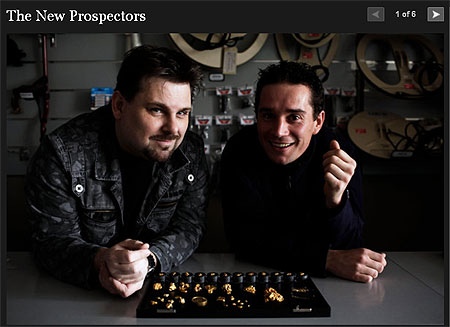
A Short “slideshow” accompanies the NYTimes article. Click here.
Last week, as concerns about the health of the global economy widened, gold hit a nominal high of $1,813 an ounce after a steady three-year climb. (Adjusting for inflation, gold prices would have to reach $2,300 an ounce to set a record.)
Gold prices are up 23 percent since the beginning of this year alone. As a result, more and more people are giving up lucrative jobs in cities in Australia for a chance at the quick riches and adventure offered by old-fashioned prospecting.
Australia is the world’s second-biggest producer of gold, after China. Domestic mines produced 266 tons at a value of 12 billion Australian dollars ($12.42 billion) in 2010, the consulting firm Surbiton Associates said in its latest survey of the Australian gold mining industry. By comparison, the United States produced 240 tons in 2010.
An influx of out-of-towners to prospect in Australia has been a boon for small-business owners in former gold rush towns, many of which have fallen on hard times in recent years.
Take, for example, the tiny outback hamlet of Mudgee, about 170 miles northwest of Sydney. In 1851 it had a population of just 200, before ballooning to 20,000 after the discovery of gold in nearby Hargraves, which was ground zero for the first gold rush in the history of New South Wales.
But the fortunes of Mudgee flagged along with gold prices in the last century. Young people moved to the cities in search of steady work, while punishing droughts drove away farmers. Today, there are just 8,000 people spread sparsely along lonely streets built for more than twice that many inhabitants.
Slowly but surely that has begun to change, said Kim Ellis, 47. She and her partner, Lincoln Parsons, are the proprietors of Nuggets From Down Under, a prospecting supply shop in Mudgee. Ms. Ellis says that she has seen more new arrivals walk through her shop in the last six months than in the previous five years — and that is without counting the huge number of weekend warriors and hobbyists.
“As gold prices are increasing, that’s increasing the interest in gold because of the monetary value but also because of the lifestyle,” she said. “In the last six months I’ve seen probably four people — that’s just involved with my store — four people that are quitting their jobs, selling up and going prospecting full time.”
Four may not sound like a lot, but for a town like Mudgee, every new addition is noticed — and welcome.
“People have never been really game enough to let go of their security of having their job and their home,” Ms. Ellis said. “But what I’m seeing is lifestyle change and that this is something where you can actually make money. It can be a life-changing event. All you need is a nugget, and it’s a life-changing event.”
For some, the look and feel of prospecting has changed little since the great gold rushes of the 19th century: stick a corrugated pan in a shallow creek, sift and hope.
But for the more discerning prospector, high-technology metal detectors like the Minelab GPX 4800 — about $6,000 — provide that extra advantage when hunting for the gold that may be just below the surface of the rough soil in the outback.
The global financial crisis and a general rise in commodity prices — oil and food, in particular — are the major factors propping up gold prices, analysts say. Recently, the dispute in the United States over the deficit ceiling and the downgrading of the debt rating by Standard & Poor’s have prompted an increase in the price of gold as investors have sought out an investment that is a traditional haven. Volatile stock markets and the debt crisis in Europe are also giving a lift to the metal.
“The bull market is still very much intact,” said James Steel, chief commodities analyst for HSBC in New York.
One defining feature of the current gold rush, many say, is the age of those joining up. Whereas prospecting for gold has traditionally been a hobby associated with the elderly, many of those moving out to the country are well below retirement age.
“It used to be mostly old folks at the club, but these days I’ve noticed there’s quite a few younger fellows showing up, and I think that’s mainly because of the price of gold,” said Dean Eisler, vice president of the Prospector’s Home Prospecting Club in Sydney, which runs package tours to prospect for gold.
Brian Dumesny, a 46-year-old military contractor from the city of Townsville, Queensland, in the northern Australian tropics, certainly fits that bill. A breakup with a partner helped him decide on a change of scenery, but it was the price of gold that gave him the confidence to change professions as well.
“I’ve always liked it,” he said. “Even since I was a young boy I did a little bit of panning and such, just messing around, but I guess now that in the last few years the price of gold has increased so much that it’s become so much more viable.”
Mr. Dumesny said the last nugget he had found weighed 0.3 ounce.
“Four or five years ago that was worth only a hundred bucks, and now it’s worth a bit over three hundred dollars,” he said. “So you don’t have to find a lot to be comfortable, if you know what I mean.”
That logic appeals to Mr. Steel, the HSBC analyst. Is he surprised to hear that ordinary people in Australia have been throwing in the towel on city life to prospect full time? Not at all, he says. It is a phenomenon he has seen across the world, in places like Brazil, the United States and Australia.
“What I’d like to do is go to Australia and open up my own outback saloon,” he said with a laugh.
I want one of these. But there’re no way I can justify spending $999 in-ear, custom-mouled earphones.

Stick it in your ear and all outside sound disappears. You’re left to enjoy the beauty of your own music. These things are made for professional musicians, who love them. They’re called “Ultimate Ears.” There are various models. Click here.
Yesterday was the 34th anniversary of Elvis Presley’s death.
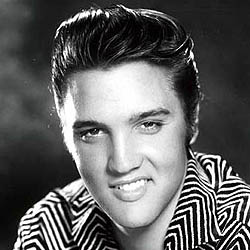
It’s so depressing I can remember the day he died. I’m that old.
Unsubcribe. You buy something online. Next, you receive 350 emails a day selling you something else. I spent an hour yesterday getting rid of about 30 “subscriptions.” I seem to have been successful.
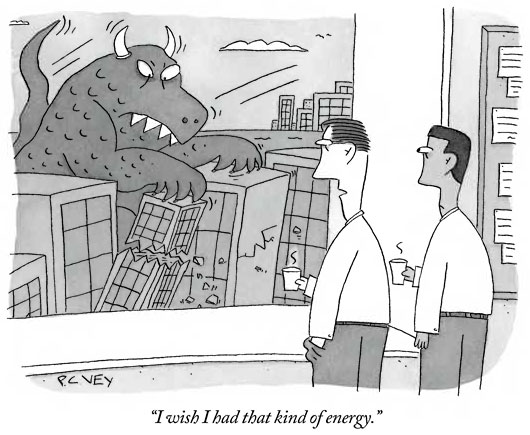
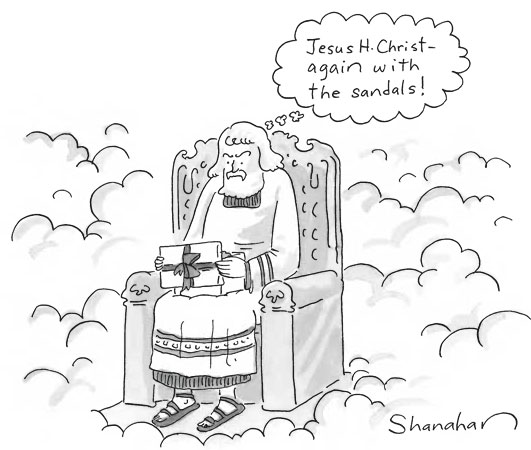
Favorite recent New Yorker cartoons.

Harry Newton who wonders why it takes so long to get over jet lag. It’s OK going west. Going east is killing. Today is the day I finally recover. I’ve decided.
Michele Bachmann is profiled in the latest New Yorker magazine.
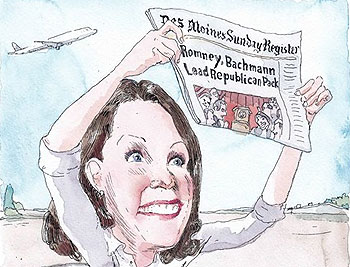
It’s worth reading. Click here.

Hi Harry, nice story on the growing gold rush in Australia and thanks for mentioning Mudgee, this was my hometown for many years. I wanted to point out that contrary to the article, Mudgee (From an Aboriginal name meaning “nest in the hills”) is a thriving picturesque community, known for its wine, farming and coal mining (Large mine is 40 miles away). Mudgee is similar to how Sonoma probably was about 15~20 years ago, an up and coming wine scene sometimes overlooked by the more popular (and over-hyped in my opinion) Hunter Valley (NSW's Napa valley) nearby. It is a favorite weekend retreat for many Sydneysiders touring the many wineries and vineyards. If you ever get the chance to visit, I highly recommend it.
Harry's back!!
Harry thanks for reminding us about the anniversary of Elvis….he was a true trail blazer. Use the link to listen to my favorite Elvis song and don't forget to turn it up……
http://www.youtube.com/watch?v…
I saw Tom Friedman of the NY Times on CNBC this morning. Michelle Caruso-Cabrera couldn't stop laughing. Why anyone would listen to anything Friedman has to say is beyond me, he is an absolute moron.
So, don't listen. Who forced you?
Watching the pompous Tom Friedman make a complete fool of himself with his dimwitted answers along with him not realizing that the CNBC hosts were laughing at him and not with him was wonderful viewing. But Harry I wouldn't waste a nano-second of my time reading a New Yorker Magazine article about anyone least of all Michele Bachmann. Thanks for the link anyway.
Harry, you know the New Yorker is going to run down any Gop contender as far right wing, not experienced, extreme, ect ect…while applauding the “smartest man ever” Barack….while America declines after Obama's nearly three year tenure…its double standard reporting….its funny, when Bush was in office and the senate and house of rep was in democratic hands all things economic were Bush's fault….Obama had both the senate and house of reps as democratic for two years and now its not Obamas fault, its congresses…..no matter what, the media is going to say how good the dems are and how bad the Gop is….its a non ending story……all this as the economy continues to lanquish…..we sink into the 'quicksand' of NO LEADERSHIP….Obama is an empty suit…..DR
Bachmann has nothing to do with Obama. I recommended reading the article because it was an interesting article. I didn't say I agree or disagreed with it.
what happened to Ron Paul?
why is the media ignoring him
his is the frontrunner not mitt romney
Ron Paul would make a fantastic Secretary of the Treasury or Fed Chairman………I would prefer to see him as the Chairman of the Fed because he would be the last Chairman of the Fed…..get it.