These trends are apparent:
1. The world’s growth is slowing.
2. Sovereign debt is a mess, and not being fixed.
3. Big banks are in big trouble, and their stock prices plummeting. We should be shorting them.
4. Technology has lost its lustrous investment appeal, because Apple dominates. And everyone else is an also-ran, including Dell, HP, RIM, etc.
5. Interest rates are staying down. Hence companies that benefit by big spreads — borrow cheap, lend high — are doing well. Hence mortgage REITs.
6. Investors are panicking because this is a new world. Nothing that’s in the textbooks works any longer. Hence they panic. Get super optimistic one day. Super pessimisstic the following. (Looks like today we face pessimism.)
7. Gold is skyrocketing — not because it produces earnings, but because it alleviates fear.
As an investor, you have two choices: Go to cash (or Australian CDs — see below) and go play tennis.
Or, buy gold and mortgage REITs. Short financials and try to play the market. Stay glued to your screens. so you can pull the trigger.
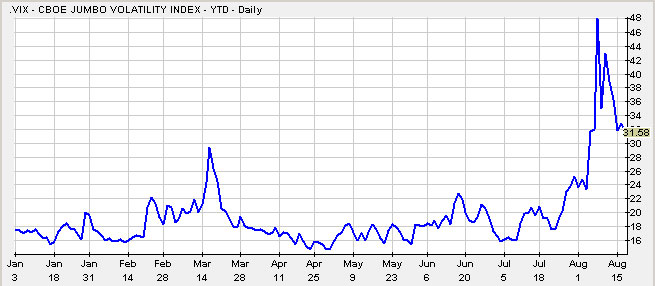
Soon, you’ll also be able to buy long-term put options (also called LEAPs) on the major indices. That’s the classic Black Swan strategy. You get big money when there’s a big disaster. Right now these LEAPs are still pricey because the VIX is still high:
The problem in Europe. There are 16 countries on the Euro. The governments of most have borrowed too much. Many can’t pay the money back. And never will be able to.
There are three choices.
1. Break the Euro. Let some of the countries go back to their original currencies. Like the drachma. Let them default and devalue. That will screw all the banks and the people who lent them money. But they deserve it. No one should have lent Greece money. (See below.)
2. Print Euros and give them to the bad countries, like Greece. They can then use the money to pay off their old debts. This will devalue the Euro, making exporting easier. Short the Euro.
3. Do basically nothing. Advance the bad countries a little money to pay off interest as it comes due and pretend that the bonds will eventually be paid off — by growth, or higher taxation or lower government expenditures — events that won’t happen in most of the bad countries.
The third strategy is the only one that works for gutless politicians — today’s variety. By adopting this strategy, you hurt business confidence and hence growth. But they don’t care. They don’t want to be seen as the harbingrer of ultra-bad news. It’s the classic “cutting off our nose to spite your face.”
Dear reader, that is where we are today. And gold keeps going up.
So how bad is it? A recent issue of BusinessWeek had a story on How to Save Greece. It began:
Greece is a chronic defaulter. Since winning independence from the Ottoman Empire in 1832, the nation has spent half its time in various stages of default or restructuring. At one point in the middle of the 19th century, Greece was in default—meaning out of compliance with debt obligations—for 53 straight years, according to This Time Is Different: Eight Centuries of Financial Folly by economists Carmen M. Reinhart and Kenneth S. Rogoff.
If Greece defaults again, this time really will be different. The finances of the world are linked more tightly. Derivatives obscure and sometimes concentrate risks. Greece is locked into a single currency with 16 other nations. It’s possible that the global economy could get lucky, and a Greek default will be a minor event. But it’s also possible that a default would cripple a chain of vulnerable economies, including Ireland, Portugal, and Belgium. The nightmare scenario: defaults by Spain and Italy, which might thrust all of Europe into a deep recession.
When big banks fall, as they did in 2008, nations rescue them. When big nations fall, there is no one strong enough to hold the safety net. “Failure to undertake decisive action could rapidly spread the tensions to the core of the euro area and result in large global spillovers,” the International Monetary Fund, which is no stranger to sovereign debt crises, warned on June 20.
You can read the rest of the BusinessWeek article.
Structured notes strike again. Wall Street makes product, which it tries to sell you. The latest idea is a “structured note.” Give them some money. If the S&P goes up, you get to keep the gains. If it falls, the bank makes up the difference, etc. You never lose. Ha. I’ve tried these things in the past and always lost money. There’s always a catch. And you won’t find it in the small print. But it’s there. Trust me.
The docs for these notes always contain “Risks.”
One I especially love was a caveat that, in three years time when the note ends, the bank may not be exist.
Probably the only true word in the prospectus.
The great light bulb ban. Congress’ new Act starts January 1, 2012. Friends are hoarding incandescent bulbs. I’m experimenting. More in a moment. From the latest Popular Mechanics: Quality CFLs (compact fluoresecents) can be purchased at nearly any hardware store for $2 or less, a premium over incandescent that can easily be paid back in saved energy costs. Over its 10,000 hour life, a $2 14-watt CFL will burn about $15.40 worth of electicity. Over the same period a 50 cent, 60-watt incandescent would require $66 worth of power — and be replaced ten times. (That’s at least 75% savings in electricity, ignoring the cost of buying all those bulbs and your labor in replacing them all.)
CFLs don’t produce the same light as incandescent. Many people, including Susan, my wife, think CFL light is ugly. Harry’s goal in life is to fool Susan by slipping CFL bulbs into places she won’t notice. I took initial heart from our building’s superindendant. Our building, like all New York buildings, has super-snobby tenants. When our super first popped in a few of those curly (also called spiral) CFLs, the building went ballistic. Later he replaced them with CFLs that had a glass cover over the curly part. Bingo, no one complained and the building is saving several hundred dollars a month. And our super thinks our tenants are idiots.
In my CFL light bulb game, I’ve learned:
1.There are CFLs and CFLs. Some emit truly horrible harsh green light. Others actually emit relatively pleasing light.
2. CFLs inside lights with covers — i.e. table lamps — typically reflect the color of the cover. They work just fine.
3. CFLs are typically bigger and won’t fit into tight fixtures, e.g. overhead high-hat light fixtures or tight wall fixtures.
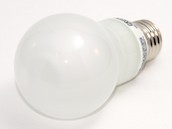
4. CFLs surrounded by glass and made to look like a “normal” incandescent typically are more pleasing. They’re called A-style bulbs:
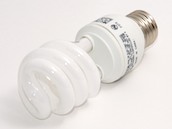
This one is called a spiral CFL and it’s ugly, but cheaper than an A-style. Bury it behind a cover and you won’t notice.
I buy bulbs from Bulbs.com, because they’re cheaper and have everything. Talk to their people. Get their advice on which CFL bulbs you can fool your Susan with. Even if you don’t save any money, the game is endlessly amusing.
Australian CDs — the latest.
Westpac CD in Aussie dollars is paying 6.21% for 5 months and 6.23% for 5 years. I’ll know more about the intermediate rates tomorrow when my new money arrives there by slow bank wire. I chose to put more money into Australia because:
+ My original monies have consistently paid 6.30% consistently. No problems.
+ Over the period of having money there, the Australian dollar has risen, giving me more gains and I believe it might rise a little more.
+ Australia has little sovereign debt – see the chart in my column a few days ago.
+ It’s good to have money outside the U.S. in a stable place like Australia or Canada because you never know what those idiots in Washington are going to do next. Except that it will be something stupid. Trust me.
Tennis is on again. It’s playing in Cincinnati. The matches feature all the tennis greats. The Tennis Channel has played it live and repeated the matches– until ESPN2 takes over live today. The final is on Sunday.
Impeccable logic. This one is really funny. Think for a second.
An old married couple is at home watching TV.
The husband had the remote and was switching back and forth between a fishing channel and the porn channel.
The wife became more and more annoyed and finally said: “For god’s sake! Leave it on the porn channel. You already know how to fish!”
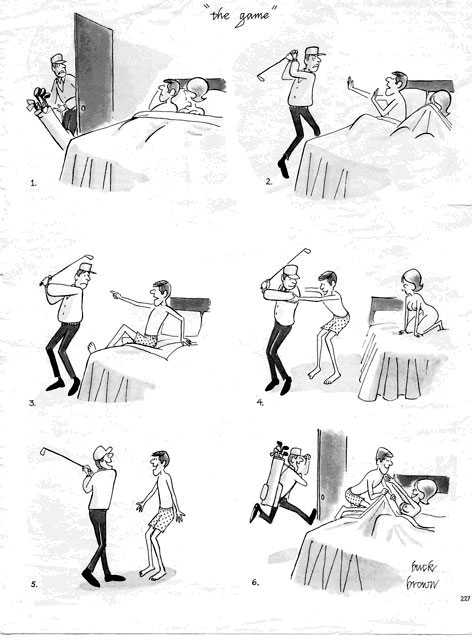
Golf wins.

Harry Newton who is playing tennis with a crook left leg. Seems to be a semi-sprain or something. Two solutions: Aleve and ignore the pain.
If you’re healthy, life is wonderful.

Harry,
What is the best way to buy Australian CDs.
Thanks,
Kyle
Greece was closed and the other in the single currency in 16 countries. It is possible that the economy will be taken away, and suspended the Greek would be a secondary event.
Table Protector
Harry — Please stop quoting the 10,000 hour life span for CFLs because, in the real world, it just ain't true. Oh sure, the thing might burn for 10,000 hours if you never turn it off, but you won't do that! You will turn it on when you go to pee, pee, and then turn it off. You will do that 10 times a day. (You're old.. I know)… A CFL has a dandy little electronics package that starts stuff up. It has many teeny parts. The parts get a hell of s surge and come into action every time you flip the switch, but they have a life measured in “starts” (with an “s”) that amounts to much less than 10,000 hours for you peeing switch flippers. Some are rated at 7000 starts and some are less. When you do the math, the payback over incandescent is… never.
In your condo hallway, where they burn for 12-24 hours a day, good deal! In your condo's bathroom, dining room, living room, or bedside table? Stupid.
PLEASE make a little note on when you superstitiously screw in those Susan-blinding CFLs. I'll bet you replace them in um…. two years.
By the way, I just spent more than $3K on LED lighting for the house in the Florida Keys. We'll never get the $$ back in power savings, but LED is cool. LED is REALLY the way you should go. CFL sucks in so many ways and is yet ANOTHER example of the Congress meddling in stuff they just don't understand because someone paid them to do it.
I've noticed LED lighting appearing in new houses and developments here in Australia – we've had CFL only globes available for a while now but it's being ignored in favour of the new technologies in LED usage. It's appearing in innovative places – small coloured (blue) strips around switches so you can see them in the dark, small strips under step ledges so you can see them in the dark. Lord knows how to replace them.
I'm not recommending them; they were featured a while back in a technology editorial and i've been waiting for them to develop further down the production stream – BluGlass (ASX : BLG).
In regards to CFL globes; I've had some that have lasted for ever and ever and some that didn't – go figure.
Harry you're turning into a gold bug. What do the West siders have to say about that, or is it one of those things that nobody talks about but everyone is doing? In other words “rich liberal behavior”……By the way Harry have you seen Robert Rubin walking around the upper west side lately?……..If you only knew what he's been up to. Hope and Change…..sure.
Harry can you give us more of a run down on the requirements to buy Westpac CD's. Is there a residency requirement and how much of the transaction can be done electronically?
There is some confusion. I'll talk to Australia this evening. Tomorrow's column will have answers, I hope.
If you haven't been to the tournament in Cincinnati I highly recommend it. Much better than the US Open! What other tournament can you go to the nearby Waffle House and sit next to Marat Safin and his two beautiful 6' Russian girlfriends…I wish I was a day trader because you can make a lot of money in this market just by playing FAZ and FAS but highly risky.
FAZ and FAS are the names of the 6' Russian Girlfriends?