Europe’s banking system is freezing up. Banks are refusing to deal with each other. Several European banks will go broke. The Eurozone experiment — one currency for 17 countries — is essentially over. Several countries will pull out, and go back to their own currencies. Those countries — e.g. Greece, Portugal and Ireland — will default on their bonds, devalue their currencies, adopt austerity programs (less government, more taxes) and, many years down the road, emerge much sounder. Basically every country (including the U.S.) has gone through this scenario — some many times.
The conclusions for us (from much reading and thinking over the weekend):
+ You must not be long stocks — any stocks. All stocks are going down, even “good” ones. I make an exception for the high dividend-yielding mortgage REITs. But I’d watch them carefully.
+ You must be long some gold, since it’s the best (and basically) only refuge for frightened money. That does not mean that it will rise inexorably day-by-day. Some days some banks will sell their holdings to provide themselves short-term liquidity.
+ You need to short the market. The easiest way is by shorting two ETFs — the SPY (the S&P 500) and the DIA (the Dow Jones 30) or buy put options on them. You need to be careful with options, the price of which tends to be high when things are squirrely — like now. Though it’s tempting, I would not try the SDS which is the leveraged ultra-short on the SPY. These ultra-shorts are designed for day by day trading — not a week or a month. The don’t work long-term, or even medium term.
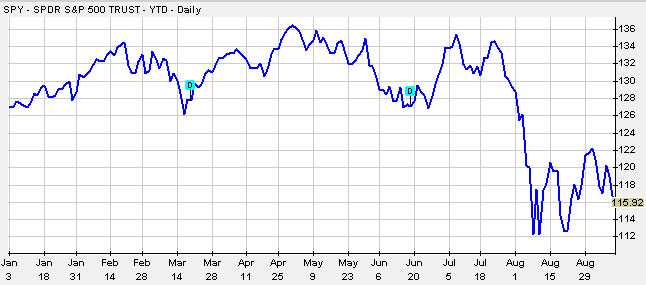
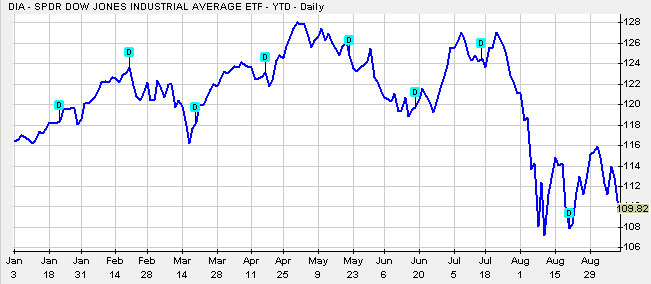
+ You could also short the Euro against the American dollar, or better the Australian dollar.
Europe is in a mess because it went to one central currency and one central bank without central fiscal control. For example, Brussels, where the Eurozone is headquartered, has basically no control over the Greek economy. The Greeks can spend irresponsibly (which they go), make their government bonds effectively worthless and there’s basically nothing Brussels can do about.
Today, Greece is several weeks away from not having enough money to pay the interest on its bonds. If it doesn’t get the money — e.g. the Germans give it to them again — then Greece will “default” on its bonds. That would screw up the finances of all the European banks that own Greek bonds. In antiipation, many banks have been refusing to deal with the “bad” banks. This is bad because in the ordinary course of day-to-day commerce, banks need to deal with each — think wire transfers, check writing, etc. This is essentially what happened in the summer of 2008 — and brought down Lehman Brothers and would have brought down much of the banking system — except for TARP and the bailout.
Of the zillions of articles I read on Europe on the weekend, here are the best:
From the Wall Street Journal:
Banker’s Exit Rattles Markets
In Europe, Top ECB Economist Resigns, Seen as Policy Protest; Dow Industrials Fall 303.68 Points
FRANKFURT—Germany’s top representative on the European Central Bank resigned in an apparent protest Friday, dealing a severe blow to the steward of Europe’s common currency amid the Continent’s worsening debt crisis.
The ECB said Jürgen Stark, its chief economist, was resigning for “personal” reasons with nearly three years remaining in his term. But people familiar with the matter said his decision was driven by frustration over the bank’s expanding role in backstopping the region’s finances.
Reuters
European Central Bank’s Executive Board member Jürgen Stark.
Mr. Stark has been the ECB’s most skeptical voice on policies to jumpstart the euro-zone economy by propping up countries such as Greece, Portugal and Italy using asset purchases or by keeping interest rates low.
The surprise exit of Mr. Stark—the second senior German official to depart the ECB over ideological differences in recent months—jolted markets in Europe and the U.S., as concerns over the stability of the central bank’s senior leadership added to fears about Greece and Europe’s banks. The euro suffered its biggest one-day drop in two months, finishing at $1.3657, its lowest finish since February.
In Germany, investors erased a small afternoon gain to finish down 4%, the lowest finish for the DAX index since July 2009. In Milan, the FTSE MIB index plunged 4.9%, also a two-year low. In the U.S., where markets opened at around the time the news was made public, the Dow Jones Industrial Average started the session sharply lower and ended the day down 303.68 points, or 2.69%, its biggest one-day drop in three weeks.
“At the very least, this adds to the uncertainty and to the sense of division among European policymakers,” JPMorgan Chase economist Greg Fuzesi wrote in a research note.
Austrian central bank governor Ewald Nowotny said Mr. Stark’s departure wouldn’t affect ECB decision-making. “The basic orientation of the ECB, which is clearly set in the EU treaty, remains untouched by the resignation of Jürgen Stark,” Mr. Nowotny said in a statement.
—————–
Controversial Journey
The ECB’s crisis response and government-bond purchases have sparked opposition in Germany.
May 2010: At a meeting in Lisbon, ECB President Jean-Claude Trichet says the purchase of government bonds hadn’t been discussed, though officials debated the idea later during post-meeting dinner at a Lisbon winery. Four days later, ECB says it will buy government bonds to alleviate tensions in financial markets. Bundesbank chief Axel Weber immediately denounces the decision. ECB board member Jürgen Stark later says he shares some of Mr. Weber’s concerns.
July 2010: Mr. Stark says if financial markets improve, “there is not a reason anymore to continue” buying bonds.
February 2011: Mr. Weber announces his resignation from the Bundesbank, denying Germany a chance to have a German at the head of the ECB.
March 2011: The ECB stops buying government bonds, a pause that will last more than four months.
May 2011: Mr. Stark warns that lending to Greek banks would be “impossible” should Greece default on its government bonds.
July 2011: Mr. Trichet signals the ECB would still accept Greek bonds even in the case of default, as long as euro-zone governments provide guarantees to the ECB.
August 2011: ECB votes to re-start bond purchases, but limits them to Irish and Portuguese bonds. Mr. Stark opposes decision, as does the new head of Germany’s Bundesbank. Four days later, the ECB expands the purchases to include Italian and Spanish bonds.
September 2011: Mr. Stark announces resignation nearly three years before his term expires.
Source: WSJ Research
———————————
The upheaval in ECB’s ranks comes at a sensitive time in Europe’s battle to bring the nearly two-year-old debt crisis on its periphery under control. Greece, the first country to seek a bailout, is once again teetering on the brink of insolvency. Investors are increasingly worried about the prospects of larger countries such as Italy and Spain.
The ECB has been at the forefront of Europe’s efforts to quell such fears. In May 2010, it started buying government bonds of Greece and other troubled euro-zone countries in a bid to keep rising borrowing costs from crippling those economies. It expanded the program last month to include Italy and Spain, and since then has bought more than €50 billion ($69 billion) in government bonds.
But the discord within the bank’s governing council is likely to raise new doubts over Europe’s ability to bring the debt crisis under control.
Critics of the ECB’s market interventions, including Mr. Stark, believe it is up to euro-zone governments, not the ECB, to rescue troubled states. By intervening so forcefully, the ECB has assumed a political role that will ultimately undermine its claim that it isn’t subject to political influence.
ECB officials have taken pains in recent weeks to counter growing criticism that the bank is overstepping its charter and assuming untold financial risk with its actions. Such worries are strongest in Germany, where the country’s own central bank, the Bundesbank, is firmly rooted on the principle of independence from politics. Many Germans believe that tradition is at the core of their country’s own economic success and worry that it is now being undermined.
“From a German perspective, this is not a very good sign,” said Kai Karstensen, an economist at Ifo Institute in Munich.
The resignation is fueling a debate in Germany about whether the euro will become a less-stable currency thanks to the escalating euro-zone debt crisis. Such a debate could indirectly make it harder for Chancellor Angela Merkel to justify expensive government policies to prop up the euro.
“Stark is the second German central banker to leave the ship because he sees that the German stability culture can’t be upheld in Europe,” says Thorsten Polleit, economist at Barclays Capital in Frankfurt. “There’s a clear potential now that the German public will become increasingly disenchanted with the euro project.”
That disenchantment is already being expressed by leading politicians. German President Christian Wulff, whose position is largely ceremonial, has called the ECB’s bond purchases “politically and legally questionable.” The head of German’s center-left SPD party, Sigmar Gabriel, has also denounced the purchases.
There are worries within Germany that vulnerable countries in Southern Europe will soon have a stranglehold on ECB decision-making. That impression could further undermine Germans’ confidence in the euro at a time when their country is being asked to foot much of the bill to bail out the flagging members.
Mr. Stark, a former top Bundesbank official and one of the ECB’s most outspoken anti-inflation “hawks,” opposed the ECB’s decision last month to reactivate its government bond purchase program, as did the head of Germany’s central bank, Jens Weidmann.
In an op-ed for the German business daily Handelsblatt, released late Friday, Mr. Stark wrote that government efforts to save the euro zone have fallen short. He called for a “far-reaching reform of the mechanism for decisions and sanctions.”
“We find ourselves in a situation in which massive sustainability risks in public budgets are eroding financial stability,” he wrote.
As head of the economics division at the ECB’s Frankfurt-based executive board, Mr. Stark has held considerable sway over the economic analysis behind the ECB’s interest-rate decisions. He will leave once a successor is appointed, which will be by the end of the year, according to bank protocol
His resignation comes at a dicey time for the ECB.
European Pressphoto Agency. Greece’s George Papandreou, left, with Jurgen Stark in May. Mr. Stark’s resignation is seen as a protest.
The eight-year term of ECB President Jean-Claude Trichet’s ends at the end of October. He will be succeeded by Mario Draghi, who currently heads the Bank of Italy. Three representatives from Southern Europe already sit on the six-member, Frankfurt-based executive board, including vice president Vitor Constancio, from Portugal. Although Germany accounts for 30% of the euro-zone economy, its officials cast the same single vote on policy as those from smaller countries.
“In a situation where a few stable economies have to bear a lot of risk on behalf of smaller, less stable countries, in such a situation Germans might start to think this is a difficult way to structure the ECB,” said Kai Carstensen, economist at think tank Ifo Institute in Munich.
German finance minister Wolfgang Schäuble told German state television Friday that Berlin will press for a German to replace Mr. Stark. No candidate has been named, but one possibility is deputy finance minister Jörg Asmussen, who has negotiated many of the euro crisis plans for Germany.
Mr. Stark’s ECB resignation follows that of former Bundesbank President Axel Weber, who resigned in April. Mr. Weber, who had been seen as the frontrunner to succeed Mr. Trichet, later cited his opposition to the ECB’s bond purchases as a factor in his decision to not seek the presidency.
Unlike Mr. Weber, who repeatedly condemned the purchases when he was at the Bundesbank, Mr. Stark refrained from publicly criticizing the move. As recently as Thursday, he told a Japanese television station that the ECB’s bond purchases, though temporary, would continue “as long as we see the risk that [the transmission of monetary policy] is impaired.”
From the Financial Times (the pink paper)
FT: Stop rejoicing. This was no victory for the eurozone.
By Wolfgang Munchau
The two real options for a resolution of the eurozone crisis came into full conflict last week. The first is a common eurozone bond. The second is a monetisation of national debt through the European Central Bank. Angela Merkel rejects the former. Europe’s central bankers reject the latter. Jürgen Stark, a member of the European Central Bank’s executive board, rejects both, and last week resigned in protest. Along with other conservative economists, he is advocating a third way, adjustment through depression – the simultaneous deleveraging of the private and public sector debt.
As an advocate of eurozone bonds, I have to admit their prospect looks grim after last week’s ruling of the German constitutional court. The court upheld the European financial adjustment facility, the crisis mechanism. This was, undoutedly, good news. But after I read the whole ruling, which ran to 29 tightly written pages, I realised that this judgement was not a victory for the eurozone at all. On the contrary, it categorically rules out any policy option beyond what has been agreed so far. I cannot see how it can be consistent with the survival of the eurozone, given the policies of member states and the ECB.
Much of the language in this document is opaque constitutional jargon. But on the issues that matter, the ruling is surprisingly, and depressingly, clear. It says the German government must not accept permanent mechanisms – as opposed to the EFSF, which is temporary – with the following criteria: if they involve a permanent liability to other countries; if these liabilities are very large or incalculable; and if foreign governments, through their actions, can trigger the payment of the guarantees. If I were a plaintiff in this case, I would regard that statement as an open invitation by the court to bring a new case against the European stability mechanism.
The ESM will be the permanent successor to the EFSF from 2013. It fulfils a good subset of those conditions. The justices ruled with a seven to one majority in this case, but later said it was a close decision. If the plaintiffs were to bring a much more focused case against a more ambitious mechanism, they might stand a better chance.
If the ESM is a borderline case under German constitutional law, there can be no such doubt about a eurobond. The court’s verdict leaves me no alternative but to conclude they are indeed unconstitutional.
Moreover, you cannot get around this unfortunate fact with an ingenious combination of eurocratic trickery and financial engineering. The court, quite cleverly, did not mention eurobonds. It talked about liabilities. The Bundestag is not precluded from giving money to Greece, but it cannot empower a third party, such as the EFSF or ESM, let alone a hypothetical European Debt Agency, from usurping sovereign power. Sovereignty can be delegated in small slices, but not permanently.
A eurobond is, of course, a permanent mechanism. It also involves a permanent loss of control. Its size is very likely to be substantial. There would not be any point in issuing a small eurobond – it would not resolve the crisis. And unless member states were to transfer some of their sovereignty to Brussels, all the inherent risks in the structure would come from non-compliance by national governments or parliaments. In other words, a eurobond perfectly matches the conditions set by the constitutional court for an arrangement that violates the German constitution.
What if the EU decided to create a fiscal union after all? The constitutional court already decided in its ruling on the Lisbon Treaty that this is not possible either. A fiscal union would require a referendum, in which the German electorate would decide to abolish the sovereign German state, and transfer sovereignty from Berlin to Brussels. Suffice to say, that this is not very likely to happen. So we have an impasse. No matter how you organise a future fiscal space in the eurozone, it will either be meaningless, or infringe the German constitution.
Moreover, the political hurdles have also gone up recently. Angela Merkel has ruled it out so forcefully that she cannot turn her back on this promise. Even the leaders of the opposition, who are more sympathetic to the idea, would find themselves constrained by the ruling.
What does this mean? First, the ruling significantly increases the probability of default by one or several member states. This is a simple consequence of the Law of Large Numbers. There are now so many hurdles in place that a systemic accident is very likely to happen at some point. Do we really think the Bundestag, after having reluctantly accepted the need for a second Greek loan programme, will vote for a third? Or a second Portuguese or second Irish programme? Will they vote Yes once the EFSF starts buying bonds, or recapitalising banks? It takes a single No vote to trigger a default. When that happens, there will be no time left for diplomacy.
The ruling leaves a post-Stark ECB as the sole backstop that could prevent a break-up of the eurozone.
From BusinessWeek:
How Long Can the ECB Prop Up Europe’s Sick Banks?
The region’s banks may have so much bad debt they won’t even lend to each other
Four years to the month since the global credit crisis began, the European Central Bank has emerged as the lender of first resort to the Continent’s broken banks. With the bond market shut off to all but the strongest lenders, the ECB’s unlimited loans are keeping the most afflicted banks in Greece, Portugal, Italy, and Spain afloat. “Banks are becoming more nervous about being exposed to other banks as they hoard liquidity and become more suspicious of other banks’ balance sheets,” Guillaume Tiberghien, an analyst at Exane BNP Paribas, wrote in a note to clients on Aug. 19.
On that date, banks deposited €105.9 billion ($152 billion) with the ECB overnight, almost three times this year’s average, rather than lend the money to other banks. They are also stockpiling dollars and hoarding cash in safe havens such as Swiss francs. “I’m not sleeping at night,” says Charles Wyplosz, director of the Geneva-based International Center for Money and Banking Studies. “We have moved into a new phase of crisis.”
Investors are concerned, too. The price of European bank stocks sank 22 percent between Aug. 1 and Aug. 22, led by Royal Bank of Scotland (RBS) (down 45 percent) and France’s Société Générale (down 39 percent). The extra yield investors demand to buy bank bonds instead of benchmark government debt surged to 2.98 percentage points on Aug. 19, the highest since July 2009, data compiled by Bank of America Merrill Lynch (BAC) show.
Despite the ECB’s best efforts, some of Europe’s banks may be inching toward insolvency. The cost of insuring the bonds of 25 European banks and insurers set a record high on Aug. 24 of 257 basis points, higher than the 149 basis-point spike when Lehman Brothers collapsed in the fall of 2008, according to the Markit iTraxx Financial Index of credit default swaps. The banks aren’t required to mark down most of their holdings of government debt to market prices. If they did, some would be forced to default or seek a bailout.
Morgan Stanley (MS) estimates that Europe’s banks need to raise €80 billion by yearend. Their ability to raise capital has been sharply curbed by investor fears. Banks in the region hold €98.2 billion of Greek sovereign debt, €317 billion of Italian government debt, and about €280 billion of Spanish bonds, according to European Banking Authority data.
The Federal Reserve, which provided as much as $1.2 trillion of loans to banks in December 2008, wound down most of its emergency programs by early 2010. One of the few exceptions is the central bank liquidity swap lines that provide dollars to the ECB and other central banks, so they can auction off the dollars to banks in their own jurisdictions.
In contrast, the ECB and its president, Jean-Claude Trichet, are still in the bank-rescuing business. “The central bank is the only clearer left to settle funds between banks,” says Christoph Rieger, head of fixed-income strategy at Commerzbank in Frankfurt. After increasing its benchmark rate twice this year to counter inflation, the ECB in August provided relief for banks by buying Italian and Spanish bonds for the first time, lending unlimited funds for six months and even providing one unnamed bank with badly needed dollars.
The ECB is maintaining a role it began in August 2007 when it injected cash into markets after they froze. The ECB’s balance sheet is now 73 percent bigger than in August 2007, and its latest round of bond buying has opened it to accusations that by rescuing profligate nations it’s breaking a rule of the euro’s founding treaty and undermining its credibility. The central bank is acting in part because governments have yet to ratify a plan to extend the scope of a €440 billion rescue facility so it can buy sovereign bonds on the open market, which would allow governments to inject capital into the banks. Although the euro zone member governments are supposed to approve the new funding by fall, no one can say for sure.
The funding difficulties of Europe’s banks is one reason cited by Morgan Stanley economists on Aug. 17 for cutting their forecast for euro-area growth to 0.5 percent next year, less than half the 1.2 percent previously anticipated. Europe’s consumers and companies are more reliant on banks for funding than their U.S. counterparts, says Tobias Blattner, a former ECB economist now at Daiwa Capital Markets Europe in London.
Lena Komileva, Group of 10 strategy head at Brown Brothers Harriman in London, says the ECB may have no option but to extend the backstop role it is playing. Refusal to do so would risk a European bank default by the end of the year, she says: “Markets are back in uncharted territory. The crisis is a whole new story now.”
The bottom line: Some European banks hold almost half a trillion euros in questionable government bonds. They’re relying on ECB funding to stay in business.
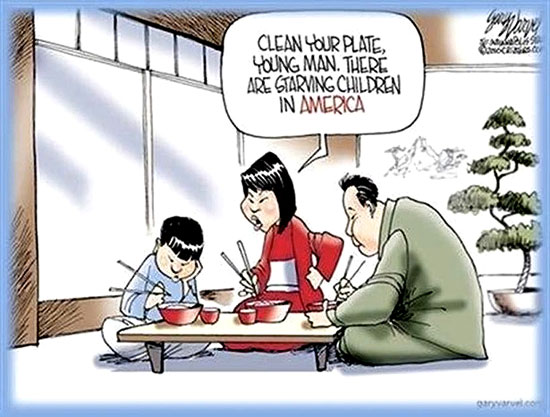
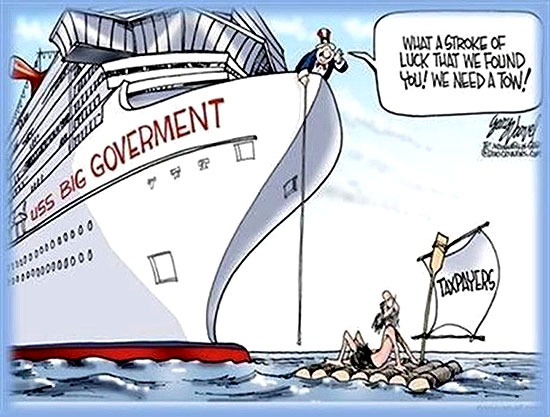
Favorite cartoons:

My favorite Jehovah’s Witness story
There was a knock on the door this past Sunday morning. I opened it to find a young, well-dressed man standing there who said:
“Hello sir, I’m a Jehovah’s Witness.” So I said “Come in and sit down.”
I offered him a fresh cup of coffee and asked “What do you want to talk about?”
He said, “I don’t know. I’ve never gotten this far before.”

Harry Newton who cried much of Sunday as he watched the 9/11 memorial ceremony and firemen documentary on CBS. Can you imagine that both the U.S. Government and Rudy Guiliani told the New York firefighters that the air at Ground Zero was perfectly safe to breath? If you haven’t learned by now not to believe anything government officials say, then you now know. They lie — often out of ignorance, but usually for political reasons — though why they lied to the brave New York City firemen beats me.
Friend and great real estate lawyer, Larry Rose, took this with his iPhone from Brooklyn last night:

Great photo. Thank you Larry.

great photo Harry – thank you. What I noticed in the very moving 9-11 documentary last night was that many firemen were not wearing breathing apparatus at all despite all the dust and obvious contaminant in the air. It was probably the immediate urgency of the situation that was at the forefront, resulting in personal safety taking a back seat. The EPA now claims that they advised rescue workers to wear air respirators (but couldn't force them) and that the air quality in lower Manhattan was safe – not at ground zero. Lots of backpedalling going on. As for Giuliani – I applaud that he rejected a $10mil donation for disaster relief from Prince Al-Waleed bin Talal, who publicly suggested that the US was responsible for the attacks. We don't need their money or reprimands.
Funny how the “air at ground zero” effected only the firemen.
You think that's funny Ronald? That the guys who were in the thick of it were the most severely affected?
Maybe they should have sued the company that made their respirators. It was a money grab by a bunch of union thugs…..pain and simple.