Points on Eurozone crisis:
1. The uncertainty is killing. It will weigh on stockmarkets, economies, and companies until there’s definitive action.
2. Whatever is decided — Greece leaves the Euro; Germany leaves the Euro, or the whole mess is bailed out by printing zillions of Euros — will lift the uncertainty and allow us all to plan, to invest, to get on with our economic lives.
3. Predicting the “best,” least painful course of action for the Europeans is impossible. The world is far too intertwined and far too complex.
The good news is that the trend is the ultimate result has to be and will be positive. Nobody — no politician, no businessman, no economist is that stupid. Ultimately, logic and prosperity prevail.
There is, sadly, a surfeit of “careerists” (people who make a living out of endlessly discussing the chaos) and a serious lack of “deciders” — people who actually make decisions and solve the problems. But the crisis is approaching . Crises happen from one day to the next — e.g. Lehmann in 2008. Critises change things, not politicians, not bankers.
The European problem is not Europe. It’s the world’s. The latest sign of interconectiveness is that our Federal Reserve Bank is offering to provide money to European banks. I’m guessing the Fed thinks spending that money is more important than fixing schools in Kansas.
For now in this ongoing uncertainty (but the certainty that there will be a crisis), gold remains king. My mortgage REITs are holding up. I have been buying a little of two new ones — MITT and MTGE — when they dip below $18.50. I own a little AMZN, AAPL and COST. But I’m staying away from everything else.
I devor news and “think” stories on the Euro Zone mess. I figure that this crisis is building to a crescendo when something will get decided. The uncertainty will break. Things will look better. And the market should perk up. For now, it’s suffering from the uncertainty.And I don’t want to be exposed to the ongoing mess. Europe is down big again today.
A decision: If in the next two weeks Greek’s lenders withhold the next €8 billion, the Greek government risks being unable to pay its wages and pensions. And that will be not be fun.
Stuff to read. From a recent New York Times:
Some in Germany Want Greece to Temporarily Exit the Euro Zone
FRANKFURT — If the European debt crisis were an old survival movie, there would be a scene in which the passengers in a lifeboat realize that they don’t have enough food and water for everyone and that someone needs to go over the side. We’re looking at you, Greece.
In fact, that is the sentiment that a growing number of reputable economists and other commentators, particularly from fully liquid Germany, have been expressing lately.
Greece, they say, should leave the euro zone for its own good, as well as the Continent’s. Some German economists argue that others in the 17-nation currency union, like Portugal or even Italy, might need to leave as well.
“It is better for all concerned, in particular for Greece, if the country leaves the euro temporarily,” Hans-Werner Sinn, president of the influential Ifo Institute at Ludwig Maximilian University in Munich, wrote in an essay published two weeks ago.
Continuing to throw money at Greece will only reduce incentives for the country to restructure its economy, he and other experts say, while pushing Europe toward a so-called transfer union, where strong countries must prop up weaker ones.
Meanwhile, Germany’s attitudes draw plenty of publicity in Greece and other stricken euro countries, where they feed stereotypes of arrogant, domineering Germans and stoke the resentments that are already deeply straining European unity.
There is no provision in European Union law for a member to be ejected, according to legal experts. Greece would have to withdraw voluntarily. But if the other countries cut off aid, it may have little choice.
Among European economists outside Germany, the idea that a country should be put under pressure to leave the euro zone is regarded generally as reckless and cruel. Greek banks would fail, the country would default on its debt and would lack a credible currency with which to buy essential imported goods like oil or food. The whole euro area, their thinking goes, would suffer as investors feared the disintegration of the currency union and perhaps the European Union itself.
“It’s very risky,” said Silvio Peruzzo, an economist in London for Royal Bank of Scotland. “It would set a precedent for other countries leaving the region. And the market would start to flirt with the idea that the euro as a whole doesn’t make sense.”
But in Germany, with its embedded fear of inflation and insistence that individuals should suffer the consequences of their actions, the idea that Greece should just leave is gaining wider currency, even in elite circles.
Otmar Issing, a former chief economist of the European Central Bank and one of the architects of the common currency, has implied that Greece should exit. Asked about his position by e-mail, Mr. Issing answered indirectly, saying that countries that break the rules of monetary union — as Greece did — should have to fend for themselves.
“If a country does not comply with the conditions agreed on, it should not get further financial aid,” he said. “A country which does not get further support has to decide what to do.”
Mr. Issing and Mr. Sinn are both extremely influential, and their thinking provides an intellectual foundation for opinions widely held by ordinary Germans. Chancellor Angela Merkel is facing intense pressure within her own center-right party, some of whose members are pushing for a special party congress to discuss the debt crisis.
Greeks, meanwhile, are as fed up with Germany as Germans are with Greece. As plumes of tear gas bathed the streets of Athens in June, for example, many protesters said they wanted the drachma back.
“We don’t care about staying in the euro,” said one protester, who gave his name only as Dimitris. “It would be costly, but at least with the drachma we would be able to control our own currency and our own future.”
Greeks have still not forgotten a cover on the German magazine Focus last year, which depicted the Venus de Milo raising a middle finger. “Cheats in our euro family,” said the headline, a reference clearly aimed at Greece.
“People believe Greeks don’t pay our taxes and we don’t want to work,” said Christos Manolas, a Greek businessman. “That’s a myth perpetuated by the Germans.”
Mr. Manolas cited a study published in June by the French bank Natixis, which found that Greeks and other south Europeans worked more hours than Germans, though the German economy was more productive.
Nor have Greeks let go of the idea that Germany owes them billions in reparations that were never paid after the brutal Nazi occupation during World War II. “We could pay off half our debts today with those reparations,” Mr. Manolas said, echoing a sentiment often expressed by his fellow citizens.
Among European economists as a whole, the idea that Greece should withdraw from the euro is seen as irresponsible, if not verging on madness. Jean-Claude Trichet, the president of the European Central Bank, has called such proposals “absurd.”
Charles Wyplosz, an economics professor at the Graduate Institute in Geneva, said the idea that Greece should spin off was “as silly as could be.”
“It would be the undermining of the euro itself,” he said. “Nobody will benefit from that.”
The German view is also based on the presumption that the northern European countries have a more virtuous record than those in the south, which has not always been true.
Early in the last decade, Germany’s budget deficit was in violation of treaty limits and its economy was one of the weakest in Europe.
But Mr. Sinn of the Ifo Institute and other German economists argue that countries like Greece will never do what they need to do to fix their economies if others keep bailing them out.
They point out that market pressure in the last week has prompted the Italian government to speed up efforts to remove barriers to entrepreneurship, after years of procrastination.
“We have seen that market pressure via higher interest rates is the most convincing sanction — if not the only one — which will trigger substantial, immediate reform measures,” Mr. Issing wrote.
Economists who say Greece should leave the euro zone acknowledge that Greek banks would probably fail and that the Greek economy would suffer a deep recession.
“Individuals would have to accept a big drop in living standards,” said Matthias Kullas, an economist at the Center for European Policy in Freiburg, Germany. “But the living standard has to fall anyway.”
The benefit would be that Greece would have its own currency and monetary policy and could devalue to recover competitiveness, he said. “It would be a very difficult adjustment process, but afterward, Greece could stand on its own two feet,” he said.
Other countries, like Italy and Portugal, might face pressure to leave the euro zone, too, Mr. Kullas said. “Some countries would suffer, and some would not be able to stay.”
But the result, he argued, would be a currency union with more integrity.
“Whoever wants to be a member of the euro zone has to follow the rules, and undertake the necessary reforms,” Mr. Kullas said. “For me that would strengthen trust in the euro.”
From the latest Economist:
The costs of break-up
After the fall. The aftermath of disaster is all the more frightening for being incalculable
THE costs of efforts to save the euro are justified by the claim that the alternative would be too dreadful to contemplate. But economic history is littered with examples of fixed exchange rates that came unfixed; the disuniting of currency unions, though rarer, happens from time to time. So how do the costs of sustaining the euro compare with the costs of its falling apart?
The question does not have a simple answer. For a start, there are lots of different ways to fall apart: a wholesale dissolution into the original currencies; a fissioning into northern hard-currency and southern soft-currency blocks; or the exit of a trickle of countries, or just one. Further complexities come from the panoply of choices the departing and remaining states would make after the fall. And all this turns as much or more on law and politics as on economics.
Take two specific scenarios. Germany could leave, either on its own or with a select group of small economies—Austria, Finland and the Netherlands—as recently suggested by Hans-Olaf Henkel, a former head of the Federation of German Industries. Second, and more likely, Greece might secede or be forced out.
In each instance, the economic consequences could be devastating, argue many analysts. If Germany were to leave, its Neue Deutschmark would soar as international funk money piled into a bigger, better Switzerland, and German manufacturing firms would suffer. German banks could cope with the switch of domestic deposits and loans into the new currency, but they would have to be recapitalised because their foreign assets in euros would now be worth less in domestic terms.
If Greece were to leave, its reborn drachma would plummet—which might be good for its exporters but which would trigger what Barry Eichengreen, a monetary historian at the University of California, Berkeley, has called “the mother of all financial crises”. The devaluation of the drachma against the euro would turn any debts that remained in euros into a crippling burden. At the same time depositors, who are already edging towards the exit, would break into a headlong rush, bringing down Greece’s banking system.
A recent study by economists at UBS, a Swiss bank, suggested that the costs in each of these eventualities would be forbiddingly high. If Germany were to leave, it would incur costs worth 20-25% of GDP in the first year and then roughly half that amount in each subsequent year. If Greece were to quit, the first-year cost would be 40-50% of GDP, and subsequent annual costs would be around 15%.
Such costs dwarf the one-off expense to Germany of bailing out Greece, Ireland and Portugal were they to default. But the report is based on the extreme assumption that countries leaving the euro would have to leave the EU. There is a legal argument for this position, but politics would almost surely trump it. It would not be in the broader interest of Europe to have an embittered neighbour in the eastern Mediterranean, or to cut Germany adrift. European policymakers would be hellbent to conserve the single market rather than immolate it in the bonfire of the euros. This suggests that the economic impact of a break-up would be less catastrophic than envisaged by the UBS economists.
Don’t cry for me, Athena
What of the lessons of history? Currency unions tend to collapse as part of a broader political break-up. The rouble area did not long outlive the Soviet Union; the monetary union of the Czech Republic and Slovakia lasted only a matter of weeks. Such situations do not offer obvious parallels. But there may be an instructive precedent for Greece in Argentina’s severing of the peso’s link with the dollar during the debt and currency crisis of late 2001 and early 2002. Argentina had established something close to a monetary union with the United States in 1991 when it fixed its currency to the dollar, backing the link through the foreign-exchange reserves of a currency board. Its experience in the ensuing decade was disconcertingly similar to Greece’s after it joined the euro in 2001. Both countries initially thrived but suffered a deterioration in competitiveness and in their public finances. The recent plunge in the Greek economy echoes the one in Argentina before it defaulted on its debt and devalued.
That crisis was bloody, including limits on bank withdrawals—the corralito—and big losses for depositors and banks as their assets and liabilities were redenominated, each at a different exchange rate, but it proved to be a turning-point (see chart). After a further slide in output Argentina grew by 9% in 2003, and carried on at around that rate until checked by the financial crisis of 2008 and global recession of 2009 (it is currently growing at close to 10%). The resurgence in national prosperity, helped by booming global demand for agricultural commodities, has occurred despite the fact that rancorous disputes over the default have kept the country shut out of international capital markets.
That may appear an encouraging portent for Greece, if it were forced to leave the euro. Rather than the protracted process of forcing down wages to regain competitiveness, the devaluation would be a prompt remedy. Moreover, the vast bulk of Greece’s bonds are written under local law, which gives it a more-or-less-free hand to impose a much bigger haircut than the trim being planned. That will no longer be the case if the currently proposed debt exchanges go through; the new contracts, written under English law, protect investors a lot more.
But the Argentine precedent shows just how savage the crisis can be; massive social unrest, a sequence of toppled presidencies, and so on. And Greece’s crisis would be worse. For one thing, the distortions, such as a burgeoning current-account deficit, that Greece allowed to build up in the good times far exceeded Argentina’s. And on top of blocking bank withdrawals and imposing capital controls Greece would also face the massive problems of introducing a new currency in the form of new coins and notes and procedures. Everything from computers to parking meters would need to be recalibrated; a thousand new hassles would make an already dire situation worse.
But the real worry, for investors and European leaders alike, is that a Greek departure could trigger panic elsewhere, with runs on banks in Portugal and Ireland and maybe Italy and Spain. Greece is far more fully integrated into the rest of Europe’s finances than Argentina was into anyone’s. Though the euro area may have proved a disappointment in economic integration, financial integration has gone apace—which now proves the opposite of a consolation. The euro zone offers scope for contagion, and confusion, on an epic scale. That is what makes its crisis so troubling—and so hard to treat.
There are three lessons from this awful chart.
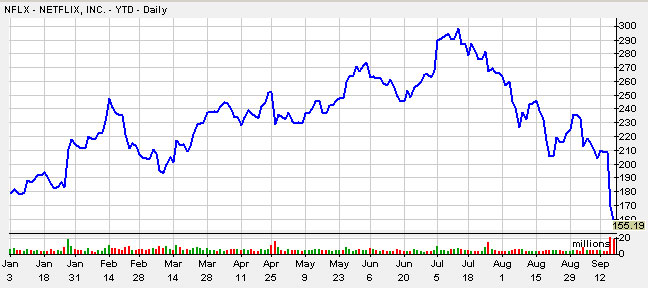
1. Our stop loss rule is involiate. When the price of a stock drops 8% or 15%, you must sell it.
2. It’s insane to catch falling knives.
3. Hot stocks often become ice-cold stocks. The lesson simple: Take profits off the table as it rises. Play with the bank’s money.
8% or 15%? I’ve always gone with 15%. But as markets have become increasingly volatile, I’ve narrowed my number.
I don’t know quite what happened to Netflix. But it was always priced on emotion not logic. Even today at its last trade of $155.19, it’s price/earnings ratio is still a hefty 39.3. That’s not nosebleed territory, but pretty close.
Wise Rabbi.
A woman goes to see her Rabbi and asks, “Isaac and Samuel are both in love with me, who will be the lucky one?”
The wise old Rabbi answers, “Isaac will marry you. Samuel will be the lucky one.”

Harry Newton who played great tennis on Sunday, lousy tennis on Saturday. The key in tennis — as in life — is not to play defensive.

The good news is that all this crap which has been building for decades, some places and countries worse than others, is finally being EXPOSED. Even the ignorant, a rather large group I might add, know something is wrong. And the solutions that don't seem to work, daaa, are being tried and EXPOSED, such as in the USA and Greece. Here it's “the government to the rescue” spending ever increasing amounts (Quick, try $2B, the $1B wasn't enough!) and in Greece it's rioting to keep their free lunches and 6 week vacations rolling (Work like the German's and Americans? What are you, crazy?).
So, we are all seeing the real world, ugly as much of it is, thanks largely to the politicians. Yes, the politicians. The big question is: will we find the proper solution, here and in Europe?
The Founders were very afraid of pure democracy (look around to see why) and purposefully created a democratic republic with strong individual and state's rights, now long gone. But, at least, current results are now out in the light. That is GOOD news.
Harry-I am surprised that you did not comment on Obama's new millionaire tax or the “buffett bill”…….as someone who invests in triple tax free munis and also invests his capital in small private upstarts I was wondering how you feel about it? Personally I think its Obama's way to stir his political base and realizes it will never pass the House. I wait for further details…..but the gist of the bill is that it is unfair that weatlhy (over $1million a year income) do not pay the same tax rate as a middle class worker making $50K is absurd……asking for higher rates on folks over $1million will hit us all bc the fact is they will have to change the capital gains rates to equal income tax rates….and remember capital gains taxes are redundant taxes…..meaning that individual has already made the income(and already paid income tax) and invests it in companies, equities and bonds etc…he gets dividends and earnings from those corporations (that is taxed again) and then when he files his taxes if he has income from those investments or has sold them for a gain he has more taxes (capital gains taxes)….yep that seems fair…..but wait lets take even more than that bc in the liberal democrats eyes..paying 15-20% capital gains taxes on income that has already been taxed twice is not enough…too funny! All I can say is my muni portfolio never looked better…..and dont even get me started on Uncle Warren…..so what do you think?
Howard – If I'm getting a dividend from my GE stock would that be considered classical “double taxation?” So this weekend we have huge demonstrations regarding the wealthy in lower Manhattan and Obama says his speech this morning has nothing to do with “class warfare”……..Gentlemen I strongly suggest that if you get an AR-15 or an M-16 that you spend the extra 50 bucks on the flash suppressor, just a suggestion…….yea, Hope and Change.