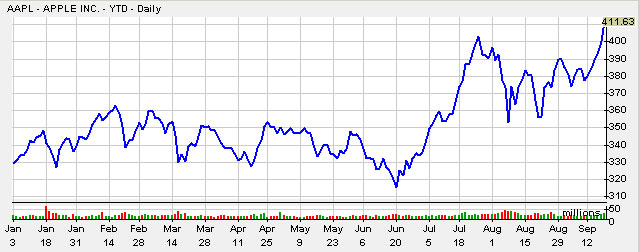
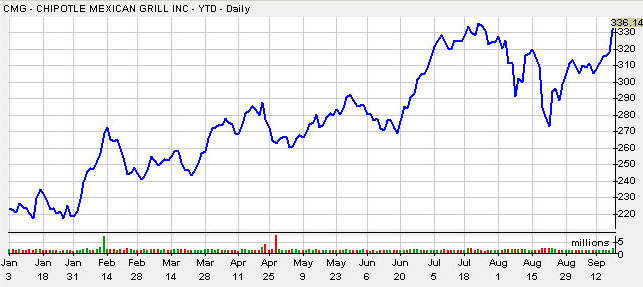
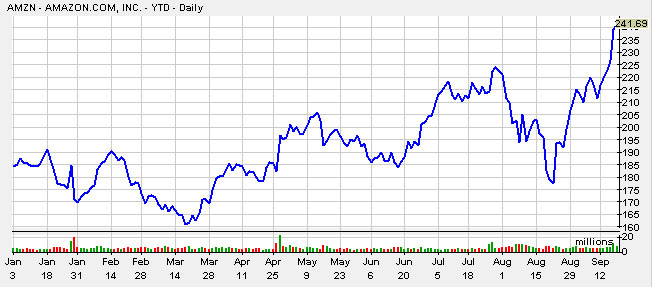
Some (a handful) of the “hot” ones are coming alive —
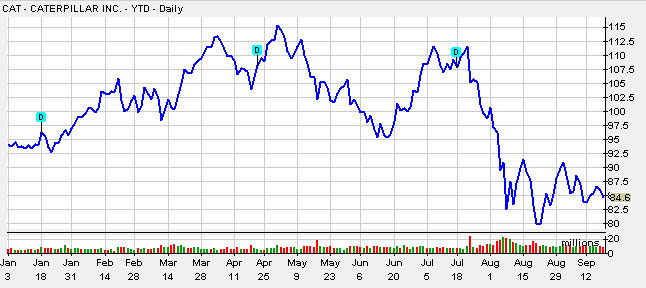
Other, erstwhile hot ones, remain firmly in the toilet, viz:
I don’t understand he huge pricing disparities among “hot” stocks, but I do continue to like Amazon and Apple, which I own.
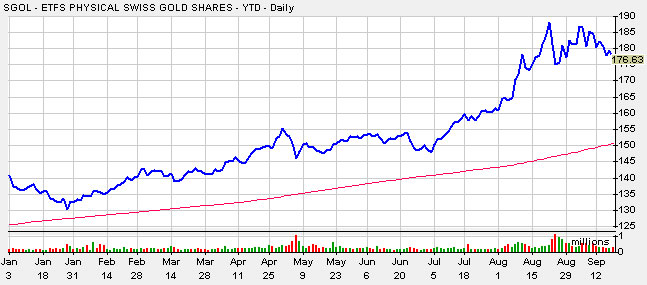
I do continue to like gold. Despite the latest pullback, it’s way above its 200-day moving average and is due for another pop.
Greece Nears the Precipice, Raising Fear. That’s the headline on the excellent New York Times story this morning. (Sorry to bore you with Greece, but it’s important. I aded the bolding.)
Slower economic growth throughout Europe, and probably in the United States. Huge losses by major European banks. Declining stock markets worldwide. A tightening of credit, making it harder for many borrowers to get loans.
As concerns grow that Greece may default on its government debt, economists are starting to map out possible outcomes. While no one knows for certain what will happen, it’s a given that financial crises always have unexpected consequences, and many predict there will be collateral damage.
Because of these fears, Greece is working frantically in concert with other European nations to avoid default, by embracing further austerity measures it has promised in return for more European bailout money to help pay its debts.
But some economists believe default may be inevitable — and that it may actually be better for Greece and, despite a short-term shock to the system, perhaps eventually for Europe as well. They are beginning to wonder whether the consequences of a default or a more radical debt restructuring, dire as they may be, would be no worse for Greece than the miserable path it is currently on.
A default would relieve Greece of paying off a mountain of debt that it cannot afford, no matter how much it continues to cut government spending, which already has caused its economy to shrink.
At the same time, however, there is a fear of the unknown beyond Greece’s borders. Merrill Lynch estimates that the shock to growth in Europe, while not as severe as in the aftermath of the financial crisis of 2008, would be troubling, with overall output contracting by 1.3 percent in 2012.
While other countries have defaulted on their sovereign debt in recent times without causing systemic contagion, analysts weighing the numbers on Greece note that its debt is far higher, so the ripple effects could be more serious.
Total Greek public debt is about 370 billion euros, or $500 billion. By comparison, Argentina’s debt was $82 billion when it defaulted in 2001; when Russia defaulted, in 1998, its debt was $79 billion.
Economists also warn that a Greek default could put further pressure on Italy, the euro zone’s third-largest economy, which, though solvent, is struggling to enact austerity measures and find a way to stimulate growth. Moreover, Italy’s government debt is five times the size of Greece’s, and concerns about Italy’s ability to meet its obligations could grow if Greece defaults.
In a new sign of trouble for the country, Standard & Poor’s on Monday cut Italy’s credit rating by one notch to A, citing its weakening economy and limited political response.
“Orderly or not, we have no idea what the effect of a default would be on other countries, especially Italy,” said Peter Bofinger, an economist who advises the German Finance Ministry. “If there is just a 5 percent chance that this affects Italy, then you don’t want to do it.”
In part, what would happen in the wake of a Greek default would depend on whether European leaders could create a firewall to control the damage from spreading widely. That would require officials to come together in ways they so far have not been able to, because it is politically unpopular in some countries to spend many billions more bailing out Greece.
In particular, work on transforming Europe’s main financial rescue vehicle, the 440 billion euro European Financial Stability Facility, would have to be fast tracked so that it would be in a position to buy European bonds and, crucially, provide emergency loans to countries that need to inject money into capital starved banks. Differences over the best way to go forward so far have delayed approval of the expanded fund.
Bailing out the banks will be crucial if Greece either defaults or imposes a hard restructuring, whereby banks would be forced to take a larger loss on their holdings compared with the fairly benign 21 percent losses that they are now being asked to accept as part of the second, 109 billion euro bailout package set for Greece in June.
Merrill Lynch, in a recent report on the contagion effect of a worst-case situation in which a severe Greek debt restructuring results in other weak European countries having to take a hit on their bonds, estimated that overall European bank losses could be as high as $543 billion. French and German banks would be the hardest hit, because they are among the biggest holders of Greek debt.
“We believe losses could be substantially larger through deleveraging and second-round effects, contagion from failure of individual banks from or outside the periphery, exposures of the nonbank financial sector,” the Merrill Lynch report concluded.
While a 60 to 70 percent debt write-down seems extreme, it actually represents the market expectation, with most Greek debt now trading below 40 cents on the dollar.
A Greek default also would be costly to the European Central Bank, the Continent’s equivalent of the Federal Reserve. To help prop up Greece, the central bank is believed to have bought about 40 billion euros in Greek bonds at much higher prices than where they now trade. If the central bank were forced to take a major loss on its Greek bonds, it too would need a capital infusion. And the burden would most likely fall on Germany.
Analysts also say the seriousness of the crisis will depend on whether Greece stays within the euro common-currency zone or is forced to leave it, and return to the drachma as its national currency.
Willem Buiter, the chief economist at Citigroup, presents two possible default outcomes. In the first, Greece forces private sector creditors to take a loss on their bonds of 60 to 80 percent but manages to stay inside the euro zone by keeping current on the smaller amount that it owes its official lenders, like the European Union and the I.M.F.
While technically a default, the loss would not be an outright repudiation of Greece’s debt and the contagion could, in theory, be contained.
One big unknown revolves around the fact that, unlike other countries that have defaulted on their debts in the past, Greece does not have its own currency.
The potentially more dangerous default outcome is if Greece decides to leave or is forced to leave the euro, according to Mr. Buiter. Then, Mr. Buiter believes, the debt write-off would approach 100 percent and the effects on international markets could be much more serious.
Offsetting this, to some extent, is the fact that exiting the euro zone and re-adopting the drachma would enable Greece to devalue its currency versus the rest of Europe, and help it become more competitive, perhaps spurring economic growth.
For the moment, Greek officials are adamant that neither a default nor a euro exit and devaluation is in the cards. One senior policy maker in Greece’s Finance Ministry, who declined to be identified because of the delicacy of the matter, even offered to send his questioner a case of 2005 Dom Perignon Champagne if Greece ever repudiated its debt.
But close followers of Greece’s budget dynamics point to the fact that, despite the country’s deficit woes, by next year Greece is likely to have achieved a primary budget surplus, meaning that after taking out the high levels of interest it pays on its debt, it will be running a surplus.
History shows that a country tends only to take such a drastic step as cutting ties with its international lenders when it has tightened its belt enough to achieve a budget surplus, and it is only payments to its bankers that is keeping it in the red.
Such was the case in most of the recent country defaults, including Argentina, Ecuador, Indonesia and Jamaica, economists at the I.M.F. found in a paper published last year that addressed when a country finds its interest is served by default.
“My view is that it is very much in Greece’s interest to default now, as there is no prospect that it can repay its debt,” said Desmond Lachman, a former I.M.F. economist at the American Enterprise Institute. “If it is inevitable that an insolvent Greece is going to have to restructure, it would be better for Greece to do it now.”
When Athletes Go Broke
A look at professional competitors who lost the millions of dollars they earned in sports. A ghoulish (and fascinating ) New York Times multi-media piece on great athletes including Mike Tyson, Scottie Pippen, and Marion Jones.

Click here.
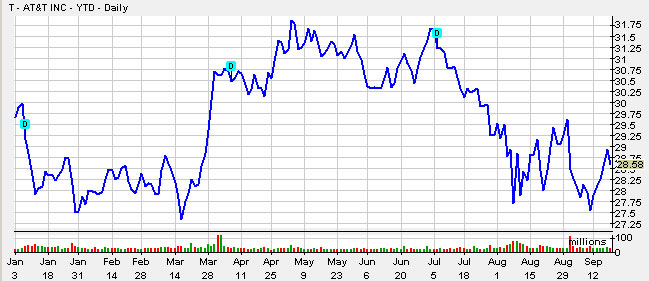
AT&T Wireless is desperate. They keep offering me free phones, free minutes, free massages. They’re totally desperate. I doubt they’ll ever be allowed to merge with T-Mobile. It would be a huge blow to the competitiveness of the cellular business.
Personally I wish AT&T would concentrate their management energies on improving their service and less on merging. AT&T wireless is a piece of drek, especially in New York City. There are vast areas you can’t get even phone service (but my wife’s Verizon phone can). I don’t even think of trying to surf the net on my AT&T iPhone. Irrespective of whatever it costs, I will switch to the iPhone 5 on Verizon, especially if it supports Verizon’s ultra speedy 4G/LTE.
AT&T’s stock now yields over 6%. Don’t let that high yield tempt you. It’s going lower.
Watch for emails bearing viruses.
Never click on attachments in emails from people you don’t know. Never click on a link in emails from people you don’t know. Yesterday I received:
ACH payment rejected.

It said: “The ACH transfer (ID: 4659060073142), recently initiated from your checking account (by you or any other person), was canceled by the Electronic Payments Association.”
Then it asks me to click on report_4659060073142.pdf.exe. This file is fraudulent and contains a virus.
Erase the email immediately.
Latest New Yorker cartoons.

Harry Newton who is playing ultra nimble with his investments. We’re in tough times. I don’t like what Europe’s woes could do to us. And I don’t like what our economic woes could do to us. I don’t like financial crises. They happen so quickly and they can be devastating.

What a joke you are Harry. I have a copy of your 1st (and only) edition of Personal Real Estate Investor, Jan/Feb 2005. You are quoted as saying “First, I believe real estate is the safest and best investment for the rest of us.” Nice call. Now you are giving stock advice? My advice, be on the other side of your trade.
Actually that strategy works for many readers.
Harry – Companies cut dividends when things are not going well. NLY business model is supposed to thrive in the low interest rate environment we are currently experiencing. If rates are very lopw and NLY must cut the dividend then something is terribly wrong. You can NOT sustain 18% dividend yield. High dividend = high risk!
Something is not terribly wrong. Stop making things up.
NLY just cut the dividend! This is the begining of the end. These stocks were supposed to do well in a low interest environment. Rates are at historic lows yet the cut the dividend???What say you Harry!!!!!
I'm checking.
They got caught with mortgage prepayments.
Harry – you are a joke. ATT is yielding 6% and you say “dont let the high yield fool you”. Yet you actively recommend and promote NLY , AGNC and others yielding 18% !!! I guarentee you and all your readers ATT will be around alot longer than these mortgage backed REITs security ponzi schemes. They do not have a business. They merely raise money and play the interest rate spread between the cost of borrowing and the cost of lending with the underlying instrument being mortgage backed securities, real estate pass throughs , collaterilized mortgage obligations and all the instruments that took down our economy in the first place. You should think twice before you bash ATT (which has a real business, bricks and mortar, customers, and infrastructure) while you pump these make believe business based on real estate financing, leverage, and derivatives…shame shame….
“continues to cut government spending, which already has caused its economy to shrink”.
Let's think about this.,,cutting government spending reduces the economy. Isn't government spending funded by taking money from the economy? Maybe what is shrinking wasn't ever real. Can government spending increase the economy? Yes, if invested wisely to improve productively more than what the private sector can do.
Infrastructure spending has worked in the past
Why do people create these viruses? I know some viruses try to steal data, but others — maybe most — just wreak havoc.
because they can. Who knows the mind of bad apples? Personally, I'd rather play tennis.