Nothing is more depressing that reading depressing articles about our depressing economy. You read this stuff on long plane rides, e.g. from Saigon Vietnam to New York. There’s nobody to call. The guy next to you is snoring and probably sells zippers.
You get off the plane in New York expecting stockmarkets to have fallen through the floor. They didn’t. They went up.
Next time, skip all the depressing reading. Stay with the rule Sell Rosh Hashanah. Buy Yom Kippur.
Yom Kippur started after the close last Friday. Look at the last three days since Yom Kippur.
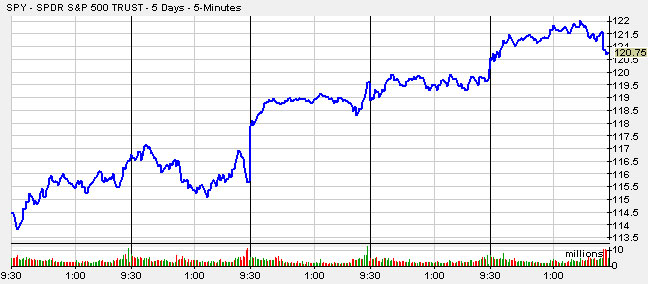
Fact is my friends (and I) are scared. Some have never been this scared.
There are three reasons they are scared:
First, they aren’t making any money. Look at this chart since end-July. This market has been going up and down faster than a whore’s drawers (Australian expression).
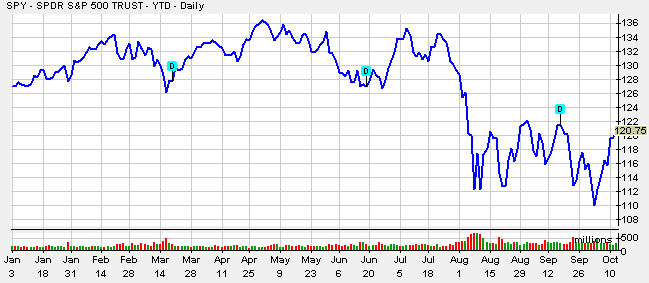
They buy something. Immediately it falls. They sell something. Immediately it rises.A huge bunch of hedge funds have gambled with heavy put options. Some have even margined their trades and lost big. Redemptions are coming at them big-time.
My philosophy is simple; When in doubt, stay out. And for God’s sake, don’t margin anything.
Second, they read the same depressing news I do. (See below.)
Third, they worry that corporate third quarter earnings won’t maintain the growth we’ve seen. They worry about how much savings via firings and expense reduction a company can do before it no longer exists.
So, right now my “brilliant” strategy is
1. Stay in gold, i.e. SGOL and GLD. In fact, buy more of it on the dips. My new friends in Vietnam love gold and believe it will hit $2,500. See below.
2. Buy more mortgage REITs on their dips. Companies like NLY, AGNC, ANH, MITT, MTGE are remarkably thinly traded. I’ll put in a low bid and hope I can snag some. I’m not worried about the mortgage REITs, though I believe that Operation Twist and mortgage prepayments by American home owners could lower their upcoming dividends. Yields, however, will remain high. Those dividends are good for my portfolio.
3. BHP looks interesting. The Australian dollar is up strongly.
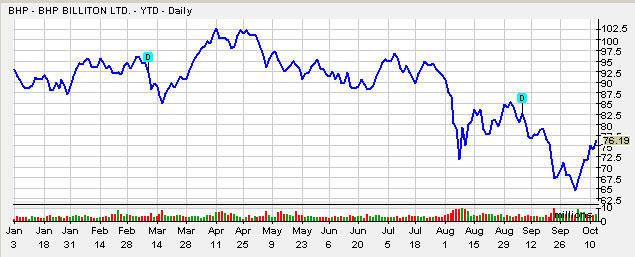
4. I’m still short the SPY. I’m now losing a little money on this hedge. I’m not big on hedging. I’d rather be out and in cash.
Stuff to read. If you have a long, boring airline flight, read this stuff. It’s ultra depressing.
+ This is the most depressing piece. It’s by Joe Nocera in the New York Times:
This Time, It Really Is Different
The title of the white paper is, admittedly, a mouthful: “The Way Forward: Moving From the Post-Bubble, Post-Bust Economy to Renewed Growth and Competitiveness.” It was commissioned by the New America Foundation, which hoped that it might “re-center the political debate to better reflect the country’s deep economic problems,” according to Sherle Schwenninger, the director of the foundation’s Economic Growth Program. Its authors are Daniel Alpert, a managing partner of Westwood Capital; Robert Hockett, a professor of financial law at Cornell and a consultant to the New York Federal Reserve; and Nouriel Roubini, who is, well, Nouriel Roubini, whose consistently bearish views have been consistently right. It is scheduled to be released on Wednesday.
I don’t know that anything at this point could re-center the political debate, so unyielding are the two parties. But as Congress prepares to take steps, through the deliberations of the already deadlocked supercommittee, that will likely further wound our ailing economy, “The Way Forward” ought to at least give our politicians pause.
Its analysis of our problems is sobering. Its proposed solutions are far more ambitious than anything being talked about in Washington. And its prognosis, if we continue on the current path, is grim. “Unless we take dramatic steps, it will be Japan all over again,” says Alpert. “Continuous deflation, no economic growth, in and out of recessions. And high unemployment.” Adds Hockett: “It will be like the economic version of chronic fatigue syndrome. A low-grade fever all the time.”
The paper’s central premise is something I’ve been hearing from Alpert for more than a year now: this time, it really is different. What he and his co-authors mean by that is that the bursting of the debt bubble three years ago was not just a severe example of the ups and downs that are an inevitable part of American capitalism. Rather, it was the ultimate consequence of the modern global economy. Chief among the changes that have taken place is the integration of China, Russia, India and other countries into the global economic mainstream. The developed world once had maybe 500 million workers. Today, say the authors, we’ve added another two billion people to the global work force.
That change alone has had a great deal to do with the stagnant wages, income inequality and the oversupply of labor in America that was masked by rising home prices and access to credit. The bursting of the bubble exposed how much the American economy depended on cheap credit. Now that the curtain has been pulled back, cheap credit alone can’t fix our problems. The country is in a deflationary cycle that is very difficult to get out of: as wages decrease (or more workers become unemployed), people become afraid to spend. Assets like homes drop in value. Businesses react by lowering prices and laying off yet more workers — which only triggers a new round of deflation. The only thing that doesn’t change is the unsustainably high debt that was accrued during the bubble.
How can we break this cycle? Like most mainstream economists, Alpert, Hockett and Roubini roll their eyes at the calls for immediate government deficit reduction, which led to the creation of the supercommittee. Reducing government spending in the short term will only make things worse.
Instead, they believe that this is perhaps the best time in recent history for the government to take on a sustained infrastructure program, lasting from five to seven years, to create jobs and demand. “Labor costs will never be lower,” says Hockett. “Equipment costs will never be lower. The cost of capital will never be lower. Why wait?” Their plan calls for $1.2 trillion in spending — not all by the government, but all overseen by government — that would add 5.2 million jobs each year of the program. Alpert says that current ideas, like tax cuts, meant to stimulate the economy indirectly, just won’t work for a problem as big the one we are facing. Indeed, so far, they haven’t.
Their second solution involves restructuring the mortgage debt that is crushing so many Americans. It is a complex proposal that involves, for some homeowners, a bridge loan, for others, a reduction in mortgage principal, and, for others still, a plan that allows them to rent the homes they live in with the prospect of buying them back one day.
Finally, they call for a “global rebalancing,” which includes a radical change in the current dysfunctional relationship between creditor and debtor nations, and even a new global currency that would be administered by the International Monetary Fund.
It is impossible to do justice to “The Way Forward” in this space. It is rich in supporting data, deeply nuanced, with as clear-eyed a view of our economic predicament as I’ve ever read. Though it is not exactly beach reading, by academic standards it is quite accessible.
You can find it at http://newamerica.net/publications/policy/the_way_forward. You should read it — even if your congressman doesn’t.
His reference is to a summary. The full paper is here.
+ This is the second most depressing piece. It’s from the Economist:
Here we go again
The Europeans are pushing the global banking system to the edge
YOU know something bad is going to happen in a horror film when someone decides to take a late-night stroll in a forest. The equivalent in finance is a bank boss insisting that his institution is completely solid.
European bankers have been saying things are fine for weeks now, even as their exposure to indebted euro-zone countries strangles their access to funding. The amount of money parked at the European Central Bank (ECB) has risen to 15-month highs as banks hold back from lending to each other. Fears of contagion from Europe have now infected America (see article). Banks there led the S&P500 into official bear-market territory this week, as the index briefly dipped more than 20% below a high set in April. The chief executive of one embattled institution, Morgan Stanley, sent a memo to employees reassuring them that the bank’s balance-sheet was dramatically stronger than it was in 2008, when Lehman Brothers collapsed.
Europe is not the only problem facing Western banks, of course. A long list of woes also includes anaemic economic growth, piles of new regulation and waves of litigation related to America’s housing bust. An ill-conceived congressional bill to punish China for manipulating its currency is yet another sign that America has little to be proud of in terms of economic policy. But the central reason to worry is the euro zone: a series of defaults there would unleash devastation, sparking big losses on European banks’ government-bond holdings, and in turn threatening anyone exposed to those banks.
Earlier this year, the prospect of another Lehman moment seemed remote. Thanks to the abject failure of Europe’s leaders since then, the similarities with 2008 are disturbingly real. Governments are once again having to step in to support their banks. France and Belgium this week said that they would guarantee the debts of Dexia, a lender that was bailed out three years ago but which is weighed down by lots of peripheral euro-zone debt. In another throwback, plans are afoot to create a “bad bank” for Dexia’s worst assets. The cost of buying insurance against bank defaults has surged: credit-default-swap spreads for Morgan Stanley and Goldman Sachs hit their highest levels since October 2008 this week. Rumours are rife: that banks cannot pledge collateral at central banks, that hedge funds are pulling their money from prime brokers.
Will the fearfulness of 2011 turn into another panic like 2008? In any sensible world, it should not. Policymakers will surely not repeat the mistake they made then, of letting a big bank go under. The asset class at the heart of this phase of the financial crisis—sovereign debt—is far easier to value than the securitised subprime mortgages that caused the trouble last time. There is much greater clarity about where exposures to dodgy government bonds lie, although American banks need to become more transparent about their ties to Europe.
What’s more, the components of a solution to the immediate euro-zone crisis, long proposed by this newspaper, are fairly well understood. First, create a firewall around other euro-zone members like Italy and Spain that are solvent but need help financing their debts; second, recapitalise the European banking system, which has done far less since 2008 to fortify its defences than America’s; and third, allow Greece, self-evidently insolvent, to default in an orderly fashion.
The problem with this solution for the rest of the world is that it depends on the Europeans to carry it out. The debt crisis has been running for 18 months now, and the only way that euro-zone leaders have dazzled is through sheer incompetence. It continued this week, with some politicians admitting that a hard restructuring of Greek debt was on the table, whilst others ruled out a default. The result is the worst of all worlds: more uncertainty for banks that hold Greek debt, more pointless austerity for the battered Greek economy (see article).
A clear plan for a forced bank recapitalisation in the euro zone is badly needed, too. The mere rumours of it happening sparked a late market rally on October 4th. There are all sorts of reasons to deplore the fact that banks would once again be propped up by public money. It would have been far better if over the past three years more had been done to boost banks’ capital and liquidity, and to create the mechanisms that would force bank losses onto creditors, not taxpayers. Every euro-zone finance minister should be forced to explain the whitewash “stress tests” that gave even Dexia a clean bill of health earlier this year. But for now the priority is to prevent a systemic meltdown, not to accelerate it for the sake of principle.
A fragmented, nation-by-nation approach to recapitalisation will not work this time, however. France and Belgium may be able to stand behind Dexia but supporting entire banking systems is beyond the capacity of many sovereigns. The European Financial Stability Facility (EFSF), the euro zone’s bail-out fund, must carry out simultaneous injections of capital into the region’s banks as soon as it can. Central banks must get into full fire-fighting mode, too. In particular, that means offers of unlimited two-year liquidity from the ECB, which was due to meet after The Economist went to press.
Above all, no amount of recapitalisation would be enough to protect banks from a cascade of euro-zone defaults. Nothing matters more than putting a firewall around the likes of Italy and Spain. Here, the news is bleak. Jean-Claude Trichet, the outgoing president of the ECB, describes this as the worst crisis Europe has faced since the second world war; but the institution he runs is unwilling to respond in kind. It is reluctant to keep buying government bonds itself, and is unimpressed by suggestions that it should boost the EFSF’s firepower by lending to it. Politicians are contorting themselves to try to strengthen the EFSF without relying on the ECB (see article).
In 2008 governments were credible backstops for their banks and the Fed, the central bank at the heart of the crisis, was willing to do everything it could to create confidence. Now the sovereigns are the problem and the ECB’s help is limited and conditional. That is the real horror film.
For the full Economist piece, click here.
+ This is marginally depressing. It’s the quarterly report from Annaly, the country’s largest (and best) mortgage REIT. I think it says they’ll muddle through.
Washington/Sovereign Watch from Annaly
Looking back at the third quarter of 2011, we are struck by how much markets and economic conditions are being driven by exogenous factors and not by the agents of economic and market activity.
There are examples large and small of how the invisible hand of economic activity is now firmly attached to the arm of an official policymaker of one kind or another. Whether you agree with it or not, the fact of the matter is that this activism or intrusion or extreme supervision, whatever you want to call it, is affecting the decisions of businesses and investors the world over.
Whatever the institution-American bodies such as the Federal Reserve, Congress, the Obama Administration or the SEC, foreign institutions such as the European Central Bank or European governments, or global entities such as the Basel Committee on Banking Supervision or the International Monetary Fund-we are witnessing the playing out of the battle between government and the marketplace for control of the economy that Daniel Yergin chronicled in “The Commanding Heights” (Simon and Schuster, 1999). This book (and the PBS documentary, which can be found here), described how for much of the 20th century, it was the state that had been winning the battle for economic control, and not until Margaret Thatcher and Ronald Reagan did market mechanisms begin to take over. In the aftermath of the credit crisis and Great Recession, and the complications of the European Monetary Union, the pendulum of history appears to be swinging back again.
Most would agree that the policy actions taken during the worst of the credit crisis were well-intended, necessary and effective at staving off a complete financial meltdown. Markets and businesses are now waiting and watching for these same governmental institutions to decide if they will lead, follow or get out of the way. Washington’s battle over raising the debt limit, which resulted in a Standard & Poor’s (S&P) downgrade, is just one example. Taken in isolation, the downgrade may not have moved the market (Chairman Ben Bernanke articulated this view in April when S&P placed the United States on credit watch: “S&P’s action didn’t really tell us anything. Everybody who reads the newspaper knows that the United States has a very serious long-term fiscal problem.”), but the rating agency hit the nail on the head regarding policymakers: “The political brinksmanship of recent months highlights what we see as America’s governance and policymaking becoming less stable, less effective, and less predictable than what we previously believed.”
The same kind of situation is playing out in Europe, where governments and europolicymakers are struggling with the challenges of keeping their system together. The choice facing Greece and its euro-brethren is default, devalue or break-up, and policymakers seem to be intent on delaying that choice as long as possible. Default isn’t so easy, given the exposures of European banks to each other’s sovereign credits. Neither is devaluing the euro a palatable option. “The decision for a single currency was a path-breaking decision and therefore we’ll defend it with all possible strength,” Germany’s Angela Merkel stated at a press conference this week, standing alongside France’s Nicholas Sarkozy. As for breaking up the countries participating in the euro, Floyd Norris of the New York Times pointed out recently that “Legally, there is no way out. The euro was designed to be the Roach Motel of currencies. Once you enter, you can never leave. There is no provision for departure.” Not to be outdone, the Federal Reserve and monetary policymakers all over the world continue to fight an economic war using war-time strategies, and other domestic regulatory bodies are pushing through aggressive regulation agendas for markets and market participants. The end result of all of these and other machinations is euphemistically called “uncertainty.”
For the full Annaly PDF, click here.
+ Will California sink the U.S.? This is a cover story on the latest Vanity Fair by my favorite financial writer Michael Lewis. It’s pretty depressing. The culprits are the police and fire unions. Their pensions are killing the cities and states.
California and Bust. The smart money says the U.S. economy will splinter, with some states thriving, some states not, and all eyes are on California as the nightmare scenario. After a hair-raising visit with former governor Arnold Schwarzenegger, who explains why the Golden State has cratered, Michael Lewis goes where the buck literally stops—the local level, where the likes of San Jose mayor Chuck Reed and Vallejo fire chief Paige Meyer are trying to avert even worse catastrophes and rethink what it means to be a society.
For the full piece, click here.
+ Everyone and their uncle wanted Elizabeth Warren in that job. But the financial lobby killed it. Suzanna Andrews in Vanity Fair, November.
The Woman Who Knew Too Much; Millions of Americans hoped President Obama would nominate Elizabeth Warren to head the consumer financial watchdog agency she had created. Instead, she was pushed aside. As Warren kicks off her run for Scott Brown’s Senate seat in Massachusetts, Suzanna Andrews charts the Harvard professor’s emergence as a champion of the beleaguered middle class, and her fight against a powerful alliance of bankers, lobbyists, and politicians.
For the full piece, click here.
Vietnam is booming, but needs some new government policies. GDP is growing at a fast 8%. But inflation is growing faster — at 20%. The place is run by the same people who kicked out the French and the Americans. Some 25 years ago, the Party liberalized the economy, in effect adopting China’s ideas about being rich is beautiful and allowing in foreign investment. Sadly, most of the presently rich people are members of the Communist Party. The 80% of the population who are farmers, salary people and small shopkeepers are getting screwed by stagnant rice prices and high inflation. There is some undercurrent of discontent that may bring people into the streets. Hence, the huge undercover police force.
There is some hope that the government may stem this discontent by announcing some economic reforms, which would probably include less government spending (the main reason for the inflation), a rise in the price of rice and other commodities, a rise in salaries and further economic liberalization, perhaps including some privatization. At present, there really isn’t a major industry the government (i.e. the Communist Party) doesn’t own — whether it’s telephones (mobile or landlines), electricity, airlines, etc.
That said, Vietnam is an impressive place. The War only ended on April 30, 1975 — 36 years. In that time the progress has been nothing short of remarkable. A true Asian miracle. Everyone has electricity. Everyone has phones. The old people like landlines. The young like cell phones. My AT&T iPhone 4 worked far better in Vietnam than it does in New York City. I could show you endless photos of cell phone towers in remote places and endless photos of high-tension electricity distirbution towers that dot the countryside. Vietnam’s investment in the infrastructure of phones and electricity putsthe U.S. to shame.
Will I invest in Vietnam? I was pitched a distress real estate fund, that plans to buy commercial buildings at 70% off. And I was pitched a gold fund, with heady talk of gold going to $2,500 an ounce by 2013. Asians love gold. If you had inflation at 20% a year, you would too. I rbought back a 100,000 dong note I didn’t spend. It’s worth $5.
As I left, I thought about the Vietnam War. America lost 58,212 people in that War with another 153,452 wounded. For what? To stop communism from engulfing Asia. I asked people if they thought about the War? The answer was No. What did they now think about? The common answer: “Money.”
Then I cast my brain to Afghanistan and Iraq. What are we still doing there? Want to be really depressed about Afghanistan? Read the latest cover story on the IEEE Spectrum.
To be rich is glorious.

Three ladies hawking HP printers in a booth outside a popular (and very crowded) Saigon computer shop. They posed for my camera. Everyone in Vietnam is ultra-friendly, and, mercifully, thin. Give them another 25 years.
Intel now has a big plant in Saigon, now called Ho Chi Minh City.
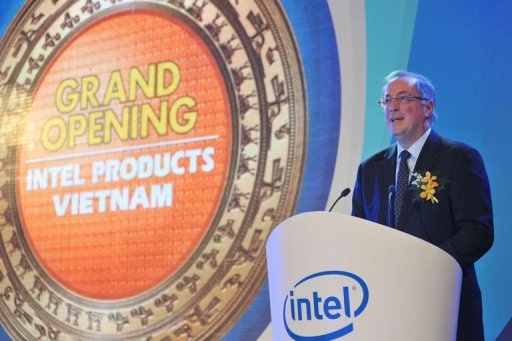
Paul Otellini, chief executive of Intel, delivers a speech at the opening October 2010 ceremony of Intel’s assembly and test facility in Ho Chi Minh City. US-based chip maker Intel opened a billion-dollar plant in Vietnam, the company’s biggest in the world,
You can’t buy a toy gun in Vietnam. They’re outlawed, as is Facebook, but not Twitter.
Favorite recent New Yorker cartoons:
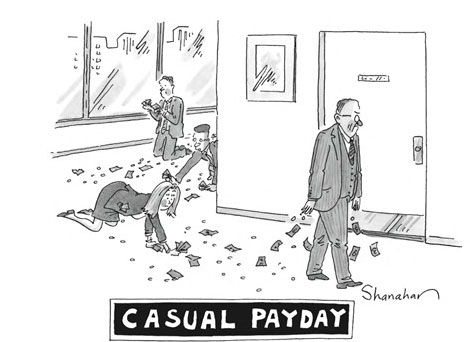
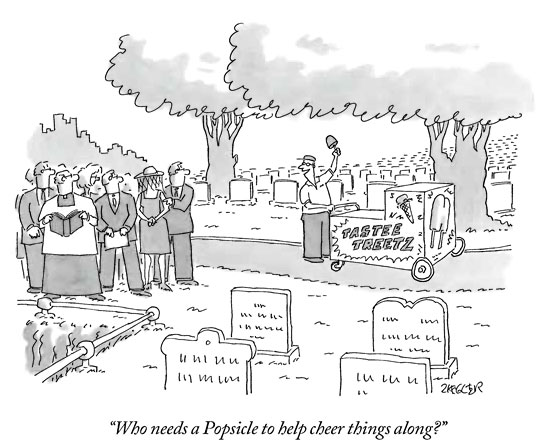
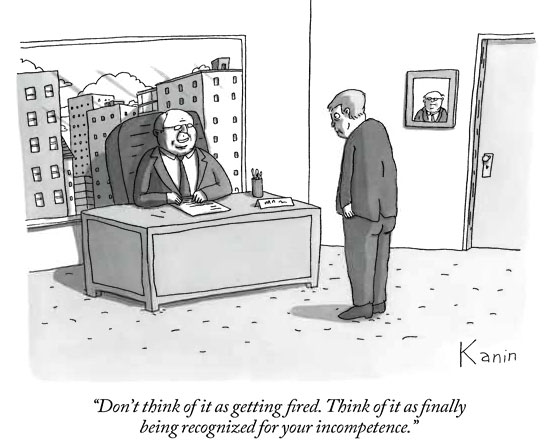

Harry Newton who has a new list of travel tips based on one premise: Traveling is unsafe. Susan got her pocketbook stolen in Phnom Penh, Cambodia. She had it snatched by a passing motorcyclist. The pockebook contained basically everything Susan owned — from her passport to her New York driver’s licence.
Rules:
1. Leave what you don’t need at home or in the hotel’s safe.
2. Back up what’s on your phone or your laptop, copy all your paperwork and know whom to call if your stuff is stolen.
3. Carry color photo copies. You don’t need originals most of the time.
4. Carry your money and credit cards in a wallet that attaches to your belt and goes inside your pants. Otherwise you WILL be pickpocketed. Trust me. I heard stories of rampant pickpoketing. Here’s a wallet from Magellans.
5. My favorite travel bag remains the Eagle Creek Hovercraft Duffel 25 inch.
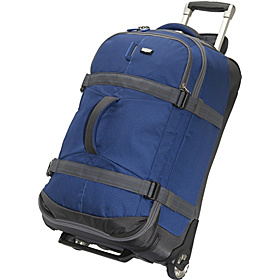
It’s theoretically too big to carry on. The allowed size is 22″ inch. But I carried this bag onto Cathay Pacific with no problem. Eagle Creek makes two models — this one which weighs 6 lbs 13 ounces and has 3,700 cubic inches. And a Hovercraft Upright 25 which weighs 8 lbs 8 ounces and which holds 4,950 cubic inches. I don’t think you can sneak the bigger one on. For more, go to Eagle Creek.
6. WiFi is everywhere. I found it in the dinkiest of airports (and always free) and the most out-of-the way hotels and restaurants. Susan carried her iPad2 and was on the Internet wherever we stopped. Ironically, the more expensive the hotel, the worse its WiFi. I never figured that one.
7. Carry an unlocked GSM cell phone. Local SIM cards are cheap.
8. Cathay Pacific and Vietnam Airlines are remarkably good airlines. They fly much newer planes than the ones we usually fly around the U.S. on.

Wandering around I came across this report on the wonders of government operations. I flashed back to the quote “Their plan calls for $1.2 trillion in spending — not all by the government, but all overseen by government —” Really, who could read this idea of “Government Leading the Way” and believe it? The Federal Government needs reduction to the lowest common denominator if the country is to survive.
TIGTA: 41% Error Rate in $30 Billion First Time Homebuyer Tax Credit ProgramThe Treasury Inspector General for Tax Administration yesterday released First-Time Homebuyer Credit Repayment Notices Were Incorrect, and the Method Used to Identify Dispositions Is Unreliable (2011-41-097):Each of the laws which provide First-Time Homebuyer Credits (Homebuyer Credit) contains different Homebuyer Credit amounts, qualification requirements, and repayment requirements. Our review identified inaccuracies relating to the issuance of Homebuyer Credit repayment notices. …The IRS reported a total of $29.7 billion in Homebuyer Credit claims were made by more than 4 million individuals as of May 7, 2011. Our overall objective was to evaluate the effectiveness of IRS processes to ensure the accurate and timely repayment of the Homebuyer Credit. …The IRS issued incorrect notices or did not send notices to 61,427 households due to notice programming errors or incorrect information on tax account. … [O]ur review of the third-party vendor’s research results for a statistically valid sample of 97 taxpayer accounts determined that for 40 (41%) of the taxpayer accounts, the information provided to the IRS had incomplete or inaccurate information.
Harry — Welcome back to Obama's America. I'm sure you have calmed yourself by thinking you'll be able to escape the Upper West Side when the time comes to security of your country house. They have an excellent police force up there so at least you have that. Well I hate to tell you but those wonderful cops are union members and the last thing they are going to do is protect you, most likely you'll have to protect yourself against them. Yea, you think I'm crazy…….think again. Be happy, you voted for it and got it. Maybe elections do have consequences? Remember those insane conservatives screaming “the return of Jimmy Carter” in 2008. You repeatedly wrote how misguided those fools were……now your wondering how you can arm yourself. Allow me to recommend something called the “AR-15″…….best of luck from your resident conservative fool.
Indeed, welcome back. I was much younger when I flew the Pacific and wouldn't do it again for all the tea in Vietnam. You amaze me, but I'm glad it's you and not me.
“Their plan calls for $1.2 trillion in spending — not all by the government, but all overseen by government —”ROFL, as they say. a. where does the money come from and b. we're going to trust the same people who brought us Pearl Harbor to protect us? What a formula for corruption. Well, I guess we could invest in Solar Energy too!
“….Vanity Fair by my favorite financial writer Michael Lewis.” Excellent insight and information in the center of the article, introduced by two pages of fluff and ended by one page of dreck. As a writer, that last page looks like filler. A real spiraling crash letdown to the article after the excellent content in the middle. But, even so, it is evident that municipalities are going to have to go through bankruptcy. Choose-your-muni- bonds-wisely was my take-away from the article.
Elizabeth Warren… You probably missed the academic cant rant that has made her famous and funny across the Internet/YouTube. I don't think you would want to live in a world run according to Elizabeth Warren… She is now coming across as a bit out of touch with reality and scary.
Because of some investments I have, I've read all I can about Operation Twist. As far as I can determine, it is another money/power grab by the Federal government. It is another FUNDAMENTAL change in ownership. REITs MUST be impacted in some significant way. I'd be wary.
Don't worry about Europe. I just read that the French and Germans have a plan to save it. What could go wrong?
Elizabeth Warren…….Communist. It's really just as simple as that. And of course we are repeatedly told that Newt Gingrich is unelectable……..and the brainwashing just keeps on going and going and going.
Harry, instead of going all the way to Vietnam you could have just driven an hour up l-95 to Bridgeport, CT.
Harry – you are so WRONG on these mortgage REITs like NLY. Using you own words “they are remarkably thinly traded” and “I believe that Operation Twist and mortgage prepayments by American home owners could lower their upcoming dividends. Yields, however, will remain high. Those dividends are good for my portfolio”. If they cut dividends (which has already been going on) and yields remain high that can only mean that the price of the stock continues to go lower. So while the dividends are good for your portfolio you continue to watch principal evaportae. There is no worse combination of thinly traded illiquid stock, with declining dividends, and falling stock price. You are dead wrong and you continue to mislead your readers. When a bond pays outsized interest payments they call them junk bonds because of the implied risk- when a stock pays outsized dividends well over and above others, its a sign that something is too good to be true. Had your readers took yor advise and bought NLY at $18 they would have already lost 15% on the stock and the dividend has already been cut. As you correctly state – dividends are likely to get cut, the stock is going lower, and it is illiquid. Really? SeriouslY? Buy more?
Welcome home Harry…we empathize with Susan…my wife Lorette lost her travel bag with both our passports and her jewelry when we were robbed in broad daylight, on a six lane highway, by highway robbers in Barcelona. Fortunately, getting replacement passports was easy in Madrid (1 hour) thanks to modern technology that maintains your photo and passport information with worldwide access by computer. Our photocopy was not needed but it helped. The robbers caused us to stop and get out of our car, then stole the travel bag from where it lay on the floor in the front seat. The police said we were lucky not to have been shot.
I always carry my wallet in my front pocket so when my pocket was picked, in a crowded railroad station in China, the only thing they got from my back pocket was a small plastic poncho that was “made in China”!
Good to have you back! As someone who is doing business in California, that article is fantastic.