Not easy. Europe in crisis. Our economy sluggish, with too much unemployment. Hugely volatile stockmarket. My standard positions in muni bonds, gold and mortgage REITs are under pressure. So?
Maybe it’s time to look at writing some covered calls. I started yesterday and found a few positions I could earn 10% on my money by writing them. The big downside is that I lose the upside if the stock rises. But I do keep the dividends. Hence write calls on decent dividend paying stocks — e.g. CL, INTC, COP, JNJ, IP and TRV.
Still mulling this one. It’s hard to see the market rising strongly in coming months. Covered calls make sense. Your thoughts? Send email. Leave a comment.
Yuch. Yuch. Yuch. The economy sucks. That’s it. That’s the summary. You want more gruesome stuff? Here’s the Fed’s position, as told by yesterday’s New York Times:
Fed Lowers Its Forecast for Growth, but Takes No Steps by By BINYAMIN APPELBAUM
WASHINGTON — The Federal Reserve significantly reduced its forecast of economic growth through 2013, acknowledging that it had once again overestimated the nation’s recovery from the 2008 financial crisis.
Despite the bleak forecast, however, the Fed said that its policy-making committee had decided against taking new measures to stimulate growth at a two-day meeting that concluded Wednesday. The Fed’s chairman, Ben S. Bernanke, said that the central bank already was pushing hard to spur growth and create jobs.
“We have taken a lot of actions,” Mr. Bernanke said at a news conference after the announcement. He added that Congress, by contrast, was not doing enough to pull the levers of fiscal policy. Lawmakers are gridlocked over a new jobs proposal from the White House, and a special bipartisan committee charged with reducing the deficit is struggling to reach agreement by Thanksgiving.
“I think it would be helpful if we could get assistance from other parts of the government to help create more jobs,” Mr. Bernanke said.
The central bank predicted that the economy would expand 2.5 percent to 2.9 percent in 2012, well below its June projection of 3.3 percent to 3.7 percent. For the following year, 2013, the Fed predicted growth of 3 percent to 3.5 percent, down from a range of 3.5 percent to 4.2 percent.
The unemployment rate, it predicted, would still be at least 8.5 percent at the end of 2012, at least 7.8 percent at the end of 2013 and at least 6.8 percent at the end of 2014. Such reductions probably would come in part from people abandoning the search for work, rather than those finding new jobs.
The unemployment rate was 9.1 percent in September. The government will release October figures on Friday.
This is a difficult time for the Fed and its chairman. Republicans charge that the central bank’s existing efforts have gone too far, sowing future inflation. Democrats say that in hesitating to do more, the Fed is ignoring the plight of more than 25 million Americans who cannot find full-time work. And the sluggish pace of growth, which continues to fall short of the Fed’s predictions, is a bright marker of its failure to stimulate a recovery.
Mr. Bernanke on Wednesday sought to argue that the Fed was trying to get things just right in maintaining a delicate but necessary balance between competing concerns about inflation and unemployment. He said that Republican critics were ignoring the Fed’s record. Five years into the crisis, there is no sign of inflation.
“The area where we have fallen short obviously is on the unemployment side,” he said. “So I think that criticisms based on the concern about inflation have so far at least not proved to be very valid.”
But Mr. Bernanke also gave little satisfaction to liberal critics. This meeting tested what the Fed was willing to do when the economy was merely muddling along, and the answer that came back: Nothing new. Asked several times why the Fed had paused if jobs are a problem and inflation is not, Mr. Bernanke offered a description but not an explanation: The Fed is willing and able to do more, he said, just not right now.
The Fed’s economic forecasts do not have a particularly good track record, but since they are based on individual forecasts submitted by the 17 members of the Federal Open Market Committee, the Fed’s policy-making board, the numbers do offer a window into the state of their minds. In a word: glum.
The Fed’s assessment of the economy was slightly brighter than after the last meeting in September. The committee’s statement noted that growth has “strengthened somewhat” since summer thanks in part to increased consumer spending. But there is still a hole in the economy where housing used to be, and the unfolding financial crisis in Europe continues to shadow the domestic economy. The statement again noted “significant downside risks to the economic outlook, including strains in global financial markets.”
Still, the decision to pause won the support of nine of the 10 voting members of the committee. The one dissent came from Charles Evans, the president of the Federal Reserve Bank of Chicago, whose vote echoed his recent speeches in which he has criticized the Fed for caring more about inflation than unemployment. It was the first time since 2007 that a board member had dissented in favor of doing more.
The limiting factor appears to be inflation. The Fed projects — as do financial markets — that prices and wages will rise about 2 percent a year, the level that the Fed considers healthy. Mr. Evans and outside critics want the Fed to trade a higher rate of inflation for reductions in unemployment. But Mr. Bernanke and a majority of his colleagues believe that this would unsettle the dearly bought belief that the Fed will keep inflation slow and steady.
The pressure to reconsider that stance has been eased by recent data, including the estimate that growth rose to an annual pace of 2.5 percent in the third quarter. There is also the question of what Congress will do: Further cuts in spending, or a decision to end the payroll tax holiday, would strengthen the case for the Fed to start new aid programs. A plan to pay down the debt would have the opposite effect.
These considerations have suspended for now any movement toward a new round of stimulus, like the proposal by the Fed Governor Daniel K. Tarullo that the Fed should resume buying large quantities of mortgage-backed securities to reduce the cost of mortgage loans, increasing demand for housing.
“While I do not shirk the responsibility of the Fed having to do what it can to meet its mandate, obviously a broad range of policies can affect growth and employment,” Mr. Bernanke said. “I hope that there will be a range of actions that will complement and supplement the Federal Reserve’s efforts.”
Mr. Bernanke indicated that the Fed does plan to expand in the near future the information that it provides about its outlook and policies. Such information can increase the power of those policies. For example, convincing investors that the Fed intends to maintain interest rates near zero for a longer period will tend to drive down rates on long-term loans — which are set in large part based on expectations about future short-term rates — thereby reducing the cost of borrowing for businesses and consumers.
A simple change would involve publishing the Fed’s predictions for the future level of the short-term interest rates, which it controls directly and has already said that it plans to hold near zero through mid-2013.
Diane Swonk, an economist at Mesirow Financial in Chicago, said the Fed could show greater concern for job creation by tying such a forecast to the unemployment rate, announcing that it would keep short-term rates near zero until unemployment dropped below 7 percent, provided that inflation remained under control.
“This is how you would move toward it,” Ms. Swonk said, referring to Mr. Bernanke’s mention of the issue during his news conference. “And I think that that is exactly where they are heading.”
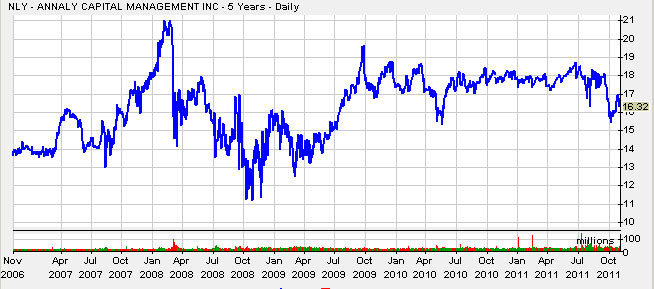
Annaly held a conference call yesterday. It wasn’t that enlightening. Company conference calls are usually populated by company boosters — shareholders and analysts who love the stock. So far, I’ve seen one upgrade on NLY — Wells Fargo Securities. Despite recent weakeness, the stock is holding in
My old commodities fund lost 4.06% YTD — to end October 31. 2011.
Matt Taibbi’s latest on MF Global. The man writes well, and colorfully. From his blog yesterday:
The MF Global Gamble and Jon Corzine’s Lost Weekend.
How about that Jon Corzine, eh? It seems New Jersey’s finest self-bought ex-Senator bet heavily on European debt, got walloped by a cavalcade of AIG-style collateral calls streaming in from outraged creditors, and tried to stave off the inevitable by commingling client cash with his own account.
From what I gather, Corzine essentially reached into the company cash register to pay off his gambling debts. He didn’t have enough money of his own to fight off the wolves, so he took the money he had access to, in a desperate, insane hope that his bets would eventually turn around and he could replace the missing cash later on.
This is the kind of crazy, stupid, panicked, extreme-short-term thinking you might see from someone at the tail end of an epic, Ray-Milland-caliber alcohol binge – when nothing matters anymore, and even concealing the crime effectively is too much of a burden, and the only thing that matters is getting through the next few minutes.
That a former U.S. Senator and head of, ahem, the world’s most powerful investment bank would stoop to such depths is being described as shocking in some quarters. The New York Times said MF’s behavior violated a “fundamental tenet of Wall Street regulation: Customers’ money must be kept separate from company money.”
Humorously, the night before it all came out, Corzine appeared at a steak dinner and wowed the crowd with a “spectacular speech” about his years running Goldman and then entering politics. “There was no sense at all that there was impending doom,” said one of the event’s attendees.
Just another thing to keep in mind when you hear all of these bank CEOs confidently denying that they’ve ever done anything wrong, or that their companies might be sitting atop ticking time bombs of toxic assets that we’ll all end up paying for. These people are fantastic liars, right up until the moment the FBI starts rifling through their filing cabinets.
Read more: Click here.
Everyone should have a friend, partner, teacher and mentor like Gerry Friesen. I’m having breakfast with Gerry today. Gerry was 60 a couple of years ago. I talked at his birthday party:
We worked successfully together for 25-plus years. It was a wonderful wonderful time. I could bore you with innumerable stories. But we’re here to celebrate Gerry.
Instead of the stories, I want to focus on why our partnership succeeded so spectacularly. And why 30 years later I’m so pleased to be standing in Colorado thousands of miles from where I live.
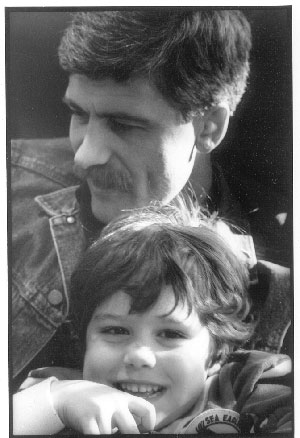
Gerry and my son Michael, eons ago. Nice photo, though.
Susan and I are particularly thrilled to be here to be here with Gerry’s wonderful and expanding family. For which I’m jealous — since I have no grandchildren, yet. I hope some of Gerry’s family may learn something about Gerry from this little talk.
All partnerships — whether marriages or businesses — are based on four human characteristics.
The first one is honesty. Gerry is the most honest person I’ve ever met. And probably ever will meet. The dictionary defines honest as trustworthy. Money is a good measure of honesty. For years we had one bank account with two people who could write and sign checks — him and me. And never once in all those years did one of us ever ask the other, “Why did you write that check? Why did you spend that money?” Neither took what we’re weren’t entitled to. And neither of questioned the other.
The second characteristic is respect. Gerry has awesome skils and great judgement. But it isn’t the skills or the judgement that are key. It’s the fact that you, the partner (i.e. me), believe they’re awesome and you respect them. It doesn’t meant that you don’t disagree with Gerry, but if you have the respect for him, (which I have) that elevates the whole discussion to a higher and more productive level. The end result is — the decision, the new business, the new magazine, the new trade show, whatever, etc. — turns out to be so much better.
The third characteristic is complementary skills. Gerry can do many things better than I can. And I can do some things better than he can. Gerry is a better salesman. But I’m a better writer. The funny thing was because we respected each other we taught each other. Of course, I’m still a lousy salesman, but Gerry turned out to a really good writer.
The fourth is commonsense. Gerry has more commonsense than I do. When you’re running a very public business like we were — a magazine publishing and trade show company — then it really helps to have someone whose feet are on the ground — and can reign in the other partner’s craziness. Over the 25 years, Gerry spent a lot of time apologizing for me. And I now formally apologize to you Gerry for all the times he fell on a sword for me. I’m no longer an asshole, I hope.
So there you have it — four human traits — total honesty, mutual respect. awesome skills and great commonsense — which I love about Gerry. Without them, I would not be where I am today. Gerry is “a once in a lifetime” person. I pray that all of you meet Your Onw Gerry. And for all I know, maybe some of you have already.
Let’s drink to Gerry.
I got into politics recently. So, now I’ll get into religion, and probably lose the rest of my readers. You must read this book:
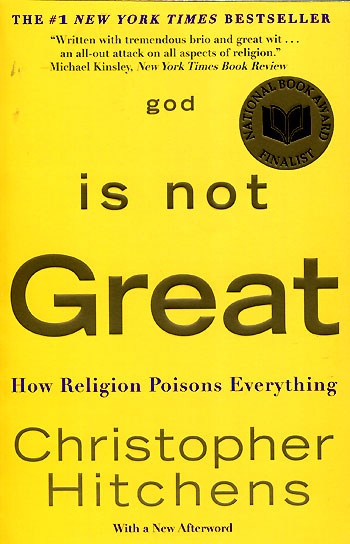
Click here.

Harry Newton who wonders why…. They’re holding an emergency meeting of the Greek cabinet today. They couldn’t have figured this out last week, last month, last year? Pull out of the Eurozone. Go back to the drachma. Devalue. Get it over with. Why prolong their (and everyone else’s) agony? It’s not as if countries devaluing their currencies hasn’t happened before.

Hard to tell who is a bigger jerk, Corzine, a lousy politician and worse banker, or Hitchens, who doesn't understand the amazing role religion has had on Western Civilization from which we've all benefited. What some people will do for money. It's good to hear believable comments about an old acquaintance, Gerry, a real person and real family. Shouldn't be on the same page with the other two!
Glad you're showing that book to a wider audience. I identify with Hitchens, and I like how aggressive he is with some of the leaders of “organized religions” he frequently debates.
It tough to “come out” as an atheist in this day and age, probably similar to admitting you were gay in the 70's.
Actually, the irony of today's column is, just above a book cover claiming that “God is not great,” Harry says, “I pray that all of you meet your own Gerry.” Praying assumes there is a Listener, and that the Listener is listening, and that the Listener cares. I have always been a bit sad for Christopher, in that he has apparently not experienced that caring for himself.
Let me add one of my favorite quotes from C.S. Lewis
A man can no more diminish God's glory by refusing to
worship Him than a lunatic can put out the sun by scribbling the word,
'darkness' on the walls of his cell.
I think if you research Hitchens you will find that he has been largely debunked by his own peers who do not respect the way he asserts his logic. Perhaps he is only doing it for the money… 😉
Harry, I'll keep my theological debate simple. That book is clever, however being clever doesn't make something true.
Note I didn't say I agreed with the books conclusions, I simply said “Read it” I like reading things that are well-written. This one is. Sadly, the author is dying. He has cancer.
good luck on getting into heaven he will get to meet the 9-11 assholes