I was sad to hear that Felix Dennis passed away. He was enormously successful in what we called “consumer” magazines — while I did well with “trade” magazines. Same time frame. Same logic.
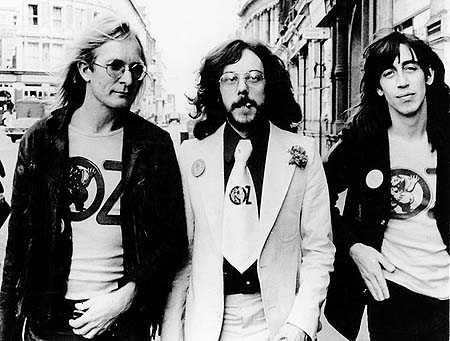
Felix Dennis, center, with James Anderson, left, and Richard Neville, editors of Oz, after being found guilty of corrupting public morals in 1971. Credit United Press International. Richard was an Australian of my generation.
Here’s the New York Times’ obituary. The part that’s best are his words on getting rich. See down below. I’ve bolded them.
Felix Dennis, a flamboyant, boastfully profligate, immensely successful British businessman who built a publishing empire that included Maxim, America’s most successful young men’s lifestyle magazine, died on Sunday at his home in Dorsington, Stratford-upon-Avon, England. He was 67.
His family said the cause was throat cancer.
Mr. Dennis drew immense attention for telling journalists over the years that he spent more than $100 million to support mistresses – he said he had 14 – and to pay for illicit drugs. (In the mid-1990s, he said, he became addicted to crack cocaine, then quit cold turkey two years later.)
He drew plaudits for the million trees he planted on his country estate with the help of a charity, and for the well-reviewed poetry – more than 1,500 published poems in eight volumes since 2002 – that he churned out in later years.
Tom Wolfe, the author, who once read some of Mr. Dennis’s poems publicly, likened the work to Kipling. Mr. Dennis’s own readings were exceptionally well attended, not least because his literary tours were truthfully titled “Did I Mention the Free Wine?”
The basis for Mr. Dennis’s wealth was an instinct for starting and producing popular magazines, including some of the first ones devoted to personal computers. Maxim and its similar offspring, he said, were intended to give men the same sort of experience Cosmopolitan gave women. He put out Blender magazine to challenge Rolling Stone, as well as gambling magazines, Men’s Fitness and The Week, a surprisingly successful news compendium.
“Is Felix Dennis mad?” The Wall Street Journal asked when The Week began publishing in the United States in 2001. Apparently not: The magazine now has a worldwide circulation exceeding 700,000 and is said to be firmly profitable.
In 2013, the British Media Awards presented Mr. Dennis with a lifetime achievement award, citing his “uncanny knack for being around at the start of every new trend in publishing.”
The Birmingham Post this January estimated Mr. Dennis’s fortune at more than $800 million. He owned a garageful of Rolls-Royces and Bentleys, a 16th-century thatched manor on his estate near Stratford-upon-Avon, a house in London, an apartment in Manhattan and houses in Connecticut and on the Caribbean island of Mustique.
Even without his undeniably vigorous self-promotion, Mr. Dennis led a life that was the stuff of legend.
He was born in Kingston-Upon-Thames in England’s Surrey County on May 27, 1947. His father went out for cigarettes when he was 3, never to return. (It turned out that he had moved to Australia.) Grandparents raised him in a house with no electricity or indoor bathroom. He left school at 15 to work as a gravedigger, store-window dresser, sign painter and blues drummer.
When the first issue of Oz, a countercultural magazine, was published, he got a job selling copies on the street. The next year he became advertising manager. By the time he was in his early 20s, he was an editor there.
For one issue, teenagers were given free rein to include whatever content they chose. One cartoon showed a bear’s genitalia. It led to a highly visible trial in 1971 in which Mr. Dennis and two other editors were charged with conspiring to corrupt public morals.
John Lennon and Yoko Ono organized protests in support of the defendants. All were convicted on lesser charges, but the judge gave Mr. Dennis a lighter sentence because, he said, he “was very much less intelligent” than the others.
The convictions were reversed by an appeals court.
After Oz folded, Mr. Dennis failed to make a go of publishing underground comics. He happened to see some teenagers lined up in the street at 9 a.m. and learned they were waiting to see a Bruce Lee martial arts film. That inspired him to start Kung-Fu Monthly, which sold millions of copies in 17 countries, commencing his empire.
Moving into the brand-new market for computer magazines, he started Computer Shopper, whose advertisements for hardware and software were said to be as closely read as the articles.
In 1995 he started Maxim, known for models whose garments always seem on the brink of falling off. Its success spawned a spinoff called Stuff.
In June 2007, Mr. Dennis sold his American magazines Maxim, Blender and Stuff to Quadrangle Capital Partners II for $250 million, according to industry estimates. He retained The Week. His company now publishes more than 50 magazines. Profits in 2013 increased more than a third over the previous year on revenues of more than $100 million.
In 2006, Mr. Dennis wrote a book, “How to Get Rich,” in which he argued that “having a great idea is overrated.” Acknowledging that this seemed counterintuitive, he went on to say, “You need great execution.”
Part of that execution was a hard-nosed negotiating style. Mr. Dennis said businessmen on the other side of the table intuitively knew his secret, a willingness to simply walk away.
“They know, in their heart of hearts, that I don’t care,” he told The Daily Mail in London.
For all the women in his life, who were reported to socialize easily with one another, Mr. Dennis had a 14-year relationship with Marie-France Desmolis, who lived in his home in Mustique. She survives him, as does his younger brother, Julian.
Last year, Mr. Dennis said his only regret was not having a child. He said his legacy would be the one million broad-leaved trees he planted on his estate in an area about seven times the size of London’s Hyde Park. His charity plans to plant nine million more.
One of his poems includes this line:
Whoever plants a tree
Winks at immortality.
Bloomberg’s section on entrepreneurs. They seem to now have a permanent section on stories about entrepreneurs. Click here.
What’s the best way to execute criminals? Good news, Ohio has finally figured it out.

For the full, tasteless, but very funny video, click here.

Harry Newton who is eyeing shorting IBM. I was surprised by yesterday afternoon’s plummet. No idea why:

TrimTabs is talking about a huge fall in the number of corporate buybacks. TrimTabs said that announced stock buybacks have slowed to $92.7 billion in the second quarter, down from $138.5 billion in the first quarter. I don’t know how important this is. But it got TrimTabs some free ink. And that’s good?
