Yesterday, I locked in some profits.
Yesterday, I panicked.
You pick. Fool or genius?
I sold a few stocks. But I especially sold gold. It was cratering. I figured a few days of cratering I’d jump back in.
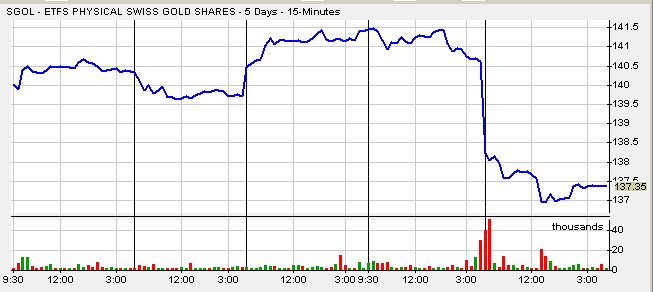
By the end of the day everything I’d sold was now selling higher. I had sold at the bottom.
I don’t like being a “day trader.” It’s totally impossible to predict market moves from day to day. We know they move for logical and illogical reasons. I remain bullish on gold and will jump back in. Probably today. Fidelity’s $7.95 trade makes it painless to play. Maybe that’s what I’m doing? Profitless play?
Coincidentally, my friend Scott Udine, the money manager, who is obsessed with capital preservation as I am, wrote his clients:
UWM Clients/Friends,
I probably get more questions and emails with regards to “stop-loss orders” than any other topic out there, so this afternoon I wanted to go over some of the things that I do with regards to protecting our capital and NEVER taking large losses in any of our positions.
First, let me start by saying that in my 20+ years of being in and around the markets, I have NEVER seen anyone that had, year in and year out success, without having a significant stop-loss strategy, hedging plan or overall risk management plan in place. The way I see it, investing in the markets without a time-tested risk management plan is like driving a car without brakes. No one in their right mind would do that as their health and well being for them and their families is too important. Well, besides their health, I would say that their hard earned capital is their next most important possession and like the car scenario, why would anyone put that possession at such great risk without proper controls in place?
I do not want to get into a lengthy discussion (call or email me if you want to delve into it further) about all the things I use in my daily arsenal to manage our stop-loss levels but I will try and make it as simple as possible as to the strategy I use. In a nutshell, let’s say I am buying a new position for a company, that has gone through all my fundamental and technical scanning and screens, at $80.00 per share. As soon as that security is purchased, I immediately put in a sell stop-loss order approximately within 3-6% of our purchase price (using trendlines, moving averages, average daily range, volatility levels, etc.). Keep in mind, it is the fundamentals and technicals that get us into a stock, but it is only the technicals that will take us out. The fundamentals on the sell side will lag for quite some time and by that time the stock will have reflected it in the price (usually down significantly). Meaning, I want to sell when the fundamentals are still stellar and peaking, not when they have started their descent.
Now, back to our above example, in my experience the best performing stocks will be the ones that you buy and immediately move higher after you purchase them. If the market is rallying and your stock is not, then there is something wrong and further research needs to be done to figure out why. Usually it means it will be the first to sell off when the market decides to pull back. So, many times, we will scratch a trade, even though we have only been in the position for a very short time. In addition, we will get stopped out of positions many times for very small losses before they take off and make us tremendous gains. There is nothing wrong with buying the stock back if need be, we do it all the time!
My short term goal with all new purchases is to get my trailing stop loss order up to our purchase price, this way enabling us to have a risk-free transaction (barring any major gaps to the downside of course). From there, I spend a significant amount of my day fine tuning our stop loss levels and making sure that they are not too tight, allowing our positions room to fluctuate somewhat. Keep in mind, this is not an exact science, more of an art, coupled with experience and watching things on a daily basis for over 20 years. As positions move significantly to the upside, some will present new add on buying opportunities, which we will take advantage of, and some will allow us to take some profits in, as to ring the register a bit. Irrespective, we will continue to raise our trailing stops and manage the downside risk very aggressively.
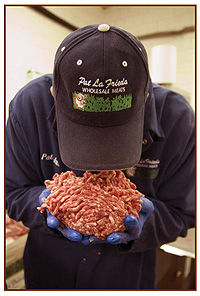
The game changing business. The high-end, quality hamburger business is exploding. New York’s unbelievably successful Shake Shack chain reflects that. Shake Shack exists because of a company called Pat LaFrieda, wholesale meat purveyors. La Frieda did to hamburgers what Netflix and Amazon did to their industries. They turned them upside down. They produce custom hamburgers from quality meat — not the left over crap you get at McDonalds or Burger King. Specialty, high-end hamburger shops are a great entrepreneurial opportunity. Pat’s website is here.
The six worst puns.
+ Evidence has been found that William Tell and his family were avid bowlers. Unfortunately, all the Swiss league records were destroyed in a fire, …and so we’ll never know for whom the Tells bowled.
+ A man rushed into a busy doctor’s office and shouted, “Doctor! I think I’m shrinking!” The doctor calmly responded, “Now, settle down. You’ll just have to be a little patient.”
+ Back in the 1800’s the Tate’s Watch Company of Massachusetts wanted to produce other products, and since they already made the cases for watches, they used them to produce compasses. The new compasses were so bad that people often ended up in Canada or Mexico rather than California . This, of course, is the origin of the expression — “He who has a Tate’s is lost!”
+ A thief broke into the local police station and stole all the toilets and urinals, leaving no clues. A spokesperson was quoted as saying, “We have absolutely nothing to go on.”
+ A famous Viking explorer returned home from a voyage and found his name missing from the town register. His wife insisted on complaining to the local civic official who apologized profusely saying, “I must have taken Leif off my census.”
+ A skeptical anthropologist was cataloging South American folk remedies with the assistance of a tribal Brujo who indicated that the leaves of a particular fern were a sure cure for any case of constipation. When the anthropologist expressed his doubts, the Brujo looked him in the eye and said, “Let me tell you, with fronds like these, you don’t need enemas.”

Harry Newton who had mixed feelings about “True Grit”, the movie he saw last night. The acting is brilliant; the story imediocre and the snakes freaked Susan.

Harry, How does gold declining by 3% or so constitute “cratering”? Plus you triggered a taxable event and rebuying with involve the friction costs of buying with spread and two commissions. Selling at a profit is not wrong but letting the market machinations or the market manipulators “play” you is worse. I've found that when faced with panic messages from the news, market, gossip,view them as bait and don't fall for the trap. As Master Buffett says, if it's a good investment, time is your very great friend. Vincent
I agree regarding True Grit. I thought it was too slow. Slow movie with great acting: Guaranteed Oscar!